The Earfull May 11, 2026
GDUs
Planting progress is rapidly moving forward even with the cold and windy conditions. This week, let’s focus on growing degree unit (GDU) tracking and early nitrogen planning. Corn development does not move by calendar date alone; it moves by heat accumulation, so the best early-season management starts with matching field observations to GDU totals and then using that information to stay ahead of nutrient demand.
The formula for GDUs: take the daily high plus the daily low, divide by two, then subtract 50. For corn, the high is capped at 86°F and the low is floored at 50°F because growth does not keep accelerating above 86°F and development slows sharply below 50°F. A simple example helps. If the high is 64°F and the low is 50°F, the average is 57. This would be a 7 GDUs day. If the high is 92°F and the low is 46°F, the adjusted values become 86 and 50, so the crop gains 18 GDUs rather than 19. That keeps the number tied more closely to how corn develops.
Emergence generally occurs after about 100 to 120 GDUs, and from emergence through about V10, leaf collars typically appear at roughly one new stage every 82 to 85 GDUs. That means GDU tracking can be turned into a practical field forecast: once a field is planted, growers can estimate when it should emerge, when it should reach key vegetative stages, and when management windows such as post herbicide or sidedress nitrogen are approaching.
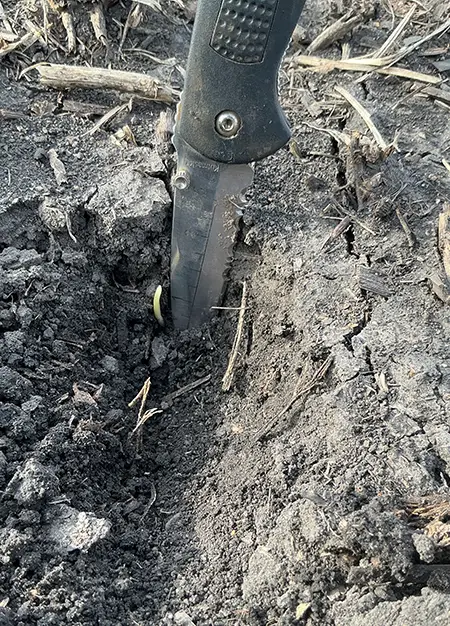
This matters most in uneven springs. Cool nights, dry topsoil, crusting, and variable residue can make neighboring fields look different even when they were planted within a day or two of each other. In those situations, GDU totals help separate true agronomic delay from visual noise. A field that has not yet accumulated enough heat for the next stage may simply be behind thermally, not necessarily in trouble.
A simple way to use GDU tracking this month is to pair three checks together. First, record planting date by field. Second, track cumulative GDUs from planting. Third, confirm actual stage by leaf collar, not plant height. Height can change fast with weather, but collar stage is the more reliable way to line up crop development with input timing. In practical terms, if a field has accumulated around 120 GDUs after planting, emergence should be close. If it has moved well beyond that and stand is still uneven, that is the time to dig, inspect seedling health, and look for moisture, crusting, insect, or disease issues rather than guessing from the road.
The next key point is that early vegetative stages set up later opportunity. Corn progresses rapidly once conditions turn favorable. Under good conditions, a young plant can unfurl a new leaf every 3 to 4 days, and later in vegetative growth leaves can appear every 2 to 3 days. That pace is why weekly scouting needs to become more disciplined in May. Fields can move from emergence to the start of rapid uptake windows in a surprisingly short stretch, especially when temperatures run slightly above average or maybe stretch out with colder than average conditions like we are seeing this year.
Tracking GDUs also improves communication across farms and teams. Saying a field is “just starting” is vague. Saying it was planted April 28, has accumulated roughly 190 GDUs, and is at V1 to V2 gives a clearer read on what should happen next and whether the crop is on pace. That kind of discipline helps prioritize scouting, herbicide timing, replant discussions, and fertility plans.
Why Sidedress Nitrogen May Deserve a Closer Look in 2026
With fertilizer costs under pressure again in 2026, sidedress nitrogen deserves renewed attention to protect both nitrogen efficiency and crop response.
In years like this, the question is not only how much nitrogen to apply, but when to put the bulk of it at risk. Wisconsin guidance has long shown that interest in sidedress nitrogen rises when fertilizer costs are high because delayed application can improve nitrogen effectiveness and help avoid some losses before the crop needs the full supply. That idea lines up well with how corn grows. Corn begins rapid growth and nitrogen uptake around the V5 to V6 stage, making the V4 to V6 period a practical target for many sidedress operations. University of Minnesota guidance similarly points to V4 to V8 as the best timing window, with sidedress no later than about V8 to V9 when a modest starter or preplant nitrogen program has already carried the crop.
The value of sidedressing is straightforward. Nitrogen placed months ahead of peak use can be vulnerable to loss from wet soils, denitrification, leaching, or surface volatilization, depending on source and conditions. By moving a meaningful share of total nitrogen closer to the crop’s demand curve, growers may reduce exposure to those loss pathways and keep more applied nitrogen available when the plant is entering rapid uptake.
This strategy is not a fit for every acre or every operation. It requires labor, equipment, timeliness, and a willingness to scout. But it can make sense where springs are wet, where soils are more prone to losses, where planting windows compress fertilizer decisions, or where a grower wants flexibility to adjust rates after seeing stand establishment and yield potential.
Source and placement still matter. Urea and UAN (28% or 32%) are common sidedress sources, but surface-applied materials can be exposed to volatilization, especially when hot and dry conditions follow application without rainfall. Where UAN is knifed in and the slot closes, a urease inhibitor is often less necessary; where urea or UAN remains on the surface, rainfall timing and inhibitor use become more important considerations. That means sidedress is not automatically efficient just because it is later. It works best when timing, source, placement, and weather are all considered together.
The 2026 takeaway is practical. If fertilizer is expensive, every pound needs a job. Tracking corn by GDU and leaf collar stage helps identify when the crop is approaching rapid nitrogen demand, and sidedressing can be one of the better tools for matching supply with that demand. Done well, it can improve efficiency, preserve flexibility, and reduce the amount of nitrogen exposed to early-season loss before the crop is ready to use it.
References
- Nielsen, R.L., Purdue University Extension. 2019. Predict Leaf Stage Development in Corn Using Thermal Time
- Bundy, L.G., Andraski, T.W., and Powell, J.M., Wisconsin Soil Science Extension. January 14, 2013.
Sidedressing Nitrogen: Useful on All Soils? - Kaiser, D.E. and Fernandez, F.G., University of Minnesota Extension. March 6, 2023.
Split-applying nitrogen for corn: Three keys for successful sidedress applications
No post found

No post found
No post found
No post found
No post found
No post found
No post found
No post found
No post found