The Earfull April 13, 2026
Corn Seedling Diseases: When Mother Nature Overwhelms Even the Best Treatments
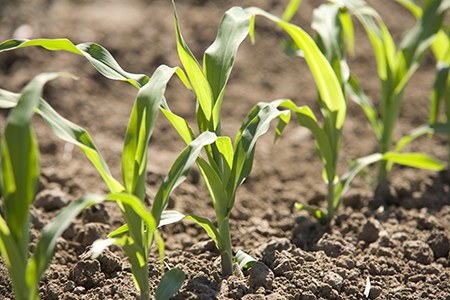
Renk Seed corn comes standard with industry-leading multi-mode seed treatment packages Metalaxyl, Fluoxastrobin, and Prothioconazole working together to protect your seedling from the moment it hits the soil. But some springs, Mother Nature tips the scales. Extended cold and wet soils after planting, or a warm saturated stretch right after emergence, can push disease pressure beyond what the seed treatment alone can fully hold back. That’s exactly why we introduced Resilient™ AP,
a planter box biological treatment designed to layer additional protection right at seeding, reinforcing root health and early vigor when conditions get tough.
The Three Main Corn Seedling Diseases
Pythium — The most common early-season threat. Thrives in cool, saturated soils (below 55°F) with standing or pooled moisture. Produces swimming spores that move through wet soil directly to the root. Infected seedlings have dark, slimy roots where the outer cortex peels away, leaving a white inner core. Seed that never emerged will be soft and rotted. Concentrated in low spots and poorly drained areas.
Fusarium — The opportunist. Covers a wider range of temperature and moisture conditions and follows plant stress, compaction, herbicide injury, temperature swings, or saturated soils. Shows up as tan to reddish-brown lesions on the mesocotyl and roots, sometimes with pink or salmon sporulation. Stressed plants invite it in; a clean planting environment keeps it at bay.
Rhizoctonia — The dry-side problem. Unlike the others, Rhizoctonia favors warmer, drier conditions and hits hardest in sandy or well-drained loam soils. Infected seedlings have firm, dry, reddish-brown lesions on the mesocotyl near the soil line, not mushy, not water-soaked. Often no obvious above-ground symptoms until the plant is stunted or chlorotic.
Resilient™ AP: Our planter box biological treatment adds beneficial microorganisms directly at seeding, colonizing the rhizosphere to compete with soilborne pathogens and support root development, extending your protection window beyond what the fungicide chemistry alone covers. In its launch year we will not have any additional supply for in-season needs.
How to Scout Corn Seedlings
Scout at emergence through V2, that’s your window before the plant either recovers or the evidence disappears. Walk problem areas and pull 10–15 plants where healthy plants transition into gaps or stunted ones.
- Examine the mesocotyl (stem between seed and soil surface) and root system after a light rinse.
- Healthy tissue is white and firm, any tan, brown, reddish, or black coloration is a red flag.
- Try peeling the outer cortex of the root. If it slides off leaving a white center, that’s Pythium.
- Firm, dry, reddish lesion at the soil line = Rhizoctonia. Mushy dark tissue = Pythium or Fusarium.
- Pythium concentrates in wet low spots. Rhizoctonia is more common on lighter, sandier soils.
Soybean Seedling Diseases: Why We Built the Defender Treatment Program
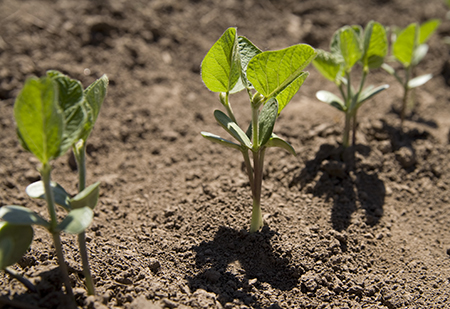
Soybeans can compensate for a lot, but they can’t compensate for plants that never made it. Soybean seedling diseases are one of the most common causes of stand loss in the Midwest, and the pathogen complex is more diverse than corn. That diversity is exactly why Renk offers the Defender treatment program. A single active ingredient isn’t enough when your field can throw Pythium, Phytophthora, Rhizoctonia, or Fusarium at you depending on soil temperature, drainage, and field history. Defender brings together the right chemistries to address these diseases.
The Four Soybean Seedling Diseases to Know
Pythium — Most common in the northern Corn Belt. Favors cool, saturated soils (50–77°F) and attacks quickly, before germination or right after emergence. Infected seeds are soft and rotted. Emerged seedlings have water-soaked lesions on the hypocotyl and cotyledons, pull from the soil with almost no resistance, and show poorly developed roots. Follows the wet spots in a field.
Phytophthora — Field-history-specific and warm-weather driven (>60°F soils + wet). Once it’s in a field, it comes back to the same low spots and high-clay areas when conditions repeat. The tell is a chocolate-brown discoloration that runs from the root up the stem, sometimes 6+ inches above the soil line, while the interior stays firm. After V2, this stem signature separates it cleanly from Pythium.
Rhizoctonia — Warm, drier conditions and sandy or south-facing soils. The lesions are firm, dry, and reddish-brown on the hypocotyl near the soil line, never mushy. Worth noting: a Rhizoctonia seedling infection that goes unnoticed in May can resurface as plant snap-off during summer wind events when the cortical rot weakens the stem base.
Fusarium — Follows stress, compaction, flooding, temperature swings, herbicide pressure. Causes brown to black root discoloration, but plants often stay standing with reduced vigor rather than dying outright. That makes it easy to miss and easy to blame on something else.
Quick Diagnostic Guide: Mushy, water-soaked tissue = Pythium or Phytophthora. Brown running up the stem above soil = Phytophthora specifically. Firm, dry reddish lesion on hypocotyl = Rhizoctonia. Brown-black root staining, plant still standing = Fusarium.
How to Scout Soybean Seedlings
Your scouting window is emergence through V2. After that, surviving plants are largely past the worst of the seedling disease risk, but the evidence of what happened is fading fast.
- Pull 10–15 plants from the edge of a problem area and examine the hypocotyl and roots.
- Check the soil line first, the classic Phytophthora brown line moves up the stem from the root.
- Mushy roots with no structure = oomycete. Firm reddish lesion on hypocotyl = Rhizoctonia. Brown-black lower root staining = Fusarium.
- After V2: Phytophthora shows stem discoloration above the soil line; Pythium damage stays at the hypocotyl and below.
- Count your stand, a final stand below 80,000 plants/acre (narrow rows) or 100,000 plants/acre (wide rows) costs yield. Run the math before replanting into June.
- Use a hand lens: Fusarium often shows pink-salmon tissue coloration. Phytophthora does not, it stays brown to tan.
Sources
- Crop Protection Network. “An Overview of Soybean Seedling Diseases.” cropprotectionnetwork.org (2026).
- University of Nebraska–Lincoln CropWatch. “Conditions Favor Seedling Diseases in Early Planted Corn and Soybeans.” cropwatch.unl.edu (2022).
- University of Wisconsin Extension. “Seed Treatment Fungicides — Corn and Soybean.” fyi.extension.wisc.edu (2010).
The Earfull April 6, 2026
Corn Planting Depth Is the Detail
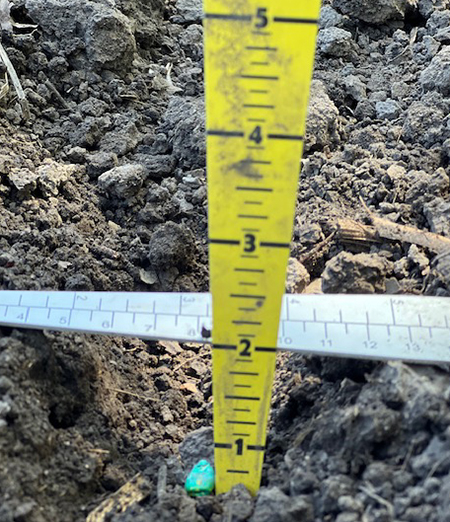
Two inches. That is the number worth remembering before a single row unit hits the ground this spring. Not 1.5, not 2.5 as a default—two inches of seed-to-soil contact in firm, moist ground sets up everything that follows. At that depth, the seed sits where soil moisture is consistent enough for uniform germination and temperature swings are buffered enough to keep imbibition steady. Move half an inch shallower and you are in the zone that dries out first after a warm afternoon. Move deeper without reason and you slow emergence, giving seedling diseases more time. The goal: get every kernel into a consistent moisture band so germination happens at roughly the same time across the field. Uniform emergence is one of the highest-value things you control at planting, and depth is the biggest lever.
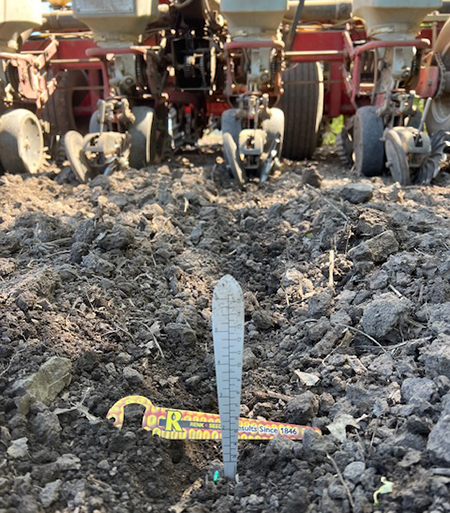
If you are going to err, err deep. Shallow planting—anything under about 1.5 inches—is where real trouble starts. Corn develops its permanent nodal roots from the crown, which forms roughly three-quarters of an inch below the soil surface regardless of seeding depth. The mesocotyl elongates upward until the coleoptile senses light, then stops. When the seed is only an inch down, the crown ends up close to the surface and nodal roots try to anchor in soil that bakes out on a sunny day. That is the setup for rootless corn syndrome—“floppy corn”—where hot, dry weather between V1 and V5 kills young roots before they establish. Seeds near the surface also sit closer to pre-emerge herbicide concentrations in the top half-inch, raising the odds of early-season injury, and they are in the part of the profile that dries fastest, making germination spotty if rain does not follow the planter. University trials consistently show that planting at one inch versus two results in less uniform stands and lower yields—in some cases the gap has been 14 percent or more.
Two inches is the target, but not a universal constant. A heavy silt loam still holding spring moisture might plant well at 1.75 inches, while a well-drained sandy loam across the road might need 2.5 inches to find consistent moisture. Early-planted fields tend to have moisture near the surface; by mid-May on lighter soil that moisture line drops and you need to follow it. Soil type, tillage, residue cover, and slope aspect all shift where the moisture band sits.
Here is what catches people: the monitor says 2 inches, the depth wheels are set, and the first check looked good. But by mid-afternoon the field has changed, or you have moved farms, or the outer-wing row units are bouncing over residue and running a quarter-inch shallow. Knolls run shallower than valleys. Headlands compact differently. The fix: stop the planter, walk back, dig five or six seeds, and measure with a ruler, a pocket knife, or the width of your thumb. Check every field, again when conditions change, once more on the knolls. Five minutes—the cheapest agronomic check available.
The consequences do not always show at emergence—they show later. If the crown formed close to the surface in May, the nodal roots are shallower than they should be all season. By late July, when the plant is filling grain and burning stalk carbohydrates, a weaker root system means less water uptake, less anchorage, and more lodging risk when a storm rolls through. You can trace a September lodging problem back to a depth decision made four months earlier. Pull a few seeds, confirm you are in moisture, and make sure every row unit is putting kernels where they belong.
Beans Are Pickier Than You Think—Here Is Why Depth Still Matters
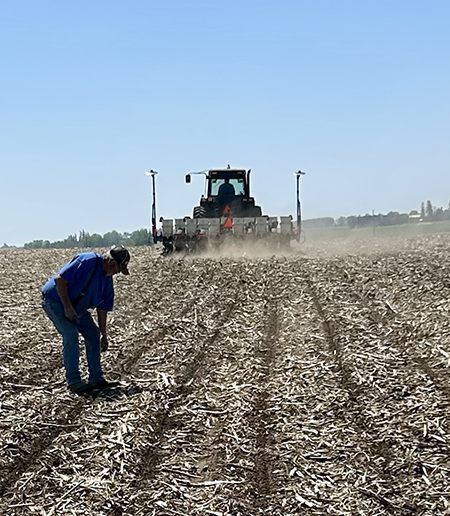
Soybeans have a tighter depth window than most people give them credit for. Under most upper Midwest spring conditions, the target is 1 to 1.5 inches, and the overriding rule is to plant into moisture. A soybean seed needs roughly half its weight in water before germination starts. If the seed is at the right depth on paper but sitting in dry soil, nothing happens until it rains—and by then you have lost days and stand evenness.
Why Beans Cannot Handle Deep the Way Corn Can
Corn pushes a coleoptile upward on a mesocotyl that can elongate from three inches or more. Soybeans do not work that way. They pull their cotyledons up through the soil on a hypocotyl arch with a smaller energy reserve and less mechanical power. Past about two inches in a heavy or crusted soil, there is a real chance the seedling runs out of stored carbohydrates before reaching daylight. The cotyledons are large relative to the stem and dragging them through dense or sealed ground takes energy a shallowly planted seed would never spend. Corn has a margin for error; soybeans do not, especially in fine-textured soils that crust after rain.
Most Fields Are Off Target—and Usually Too Deep
Depth surveys across Midwest fields consistently show that a surprising number of soybean acres are planted outside the recommended window. The most common miss is too deep, not too shallow—particularly on drill-planted acres. When our DSMs walk the soybean fields, they routinely find beans at 1.75 to 2.5 inches, especially in tilled ground where fluffy seedbeds makes it hard to gauge true depth from the cab.
Planters generally hold depth better than drills or air seeders—individual parallel-link arms with down-pressure follow contour more closely. Drills flex across their width with less unit-by-unit control, so seeds at the center can be at one depth while seeds on the wings are at another. Even on a planter, outer-wing row units often run lighter and shallower than center units in uneven terrain or heavy residue. That wing-to-center variation can be half an inch—enough to put center-row beans in moisture and wing-row beans in dry soil. Dig behind the wings, not just the center.
Cooler, wetter, heavier soils early in the season call for the shallow end—closer to 1 inch—because the seed does not need to go deep for moisture and faster emergence reduces disease exposure. Later planting, sandier ground or drier conditions push depth to 1.5 inches; in a genuinely dry spring you might go to 2 inches to chase moisture, understanding the extra risk. Seed size matters too—larger seed carries more energy for deeper emergence but bigger cotyledons are harder to pull through a crusted surface. Factor the variety’s emergence score and the soil type into the decision, not just the calendar.
Dig seed every few fields, check actual depth against the monitor, and confirm the seed is in at least half an inch of moisture. Check behind the wings, not just the center. Adjust before you plant another 40 acres at the wrong setting. Soybean stands are hard to fix after the fact—you cannot profitably re-plant a thin spot and you cannot add roots to a plant that exhausted itself emerging from too deep. Take the five minutes. It pays.
Sources
1. Purdue University Extension, Pest & Crop Newsletter—“How Deep Should Corn Be Planted?” and “Rootless or Floppy Corn Syndrome.” https://extension.entm.purdue.edu/newsletters/pestandcrop/
2. Michigan State University Extension—“Soybean Planting Depth Matters.”
https://www.canr.msu.edu/news/soybean_planting_depth_matters
3. Iowa State University Extension, Integrated Crop Management—“Soybean Seed Depth in Dry Conditions.”
https://crops.extension.iastate.edu/post/soybean-seed-depth-dry-conditions
No post found

No post found
No post found
No post found
No post found
No post found
No post found
No post found
No post found