2026 Midseason Crop Outlook: Getting In Your Fields Before Harvest
Season 2, Episode 4
2026 Mideason Crop Outlook: Getting In Your Fields Before Harvest
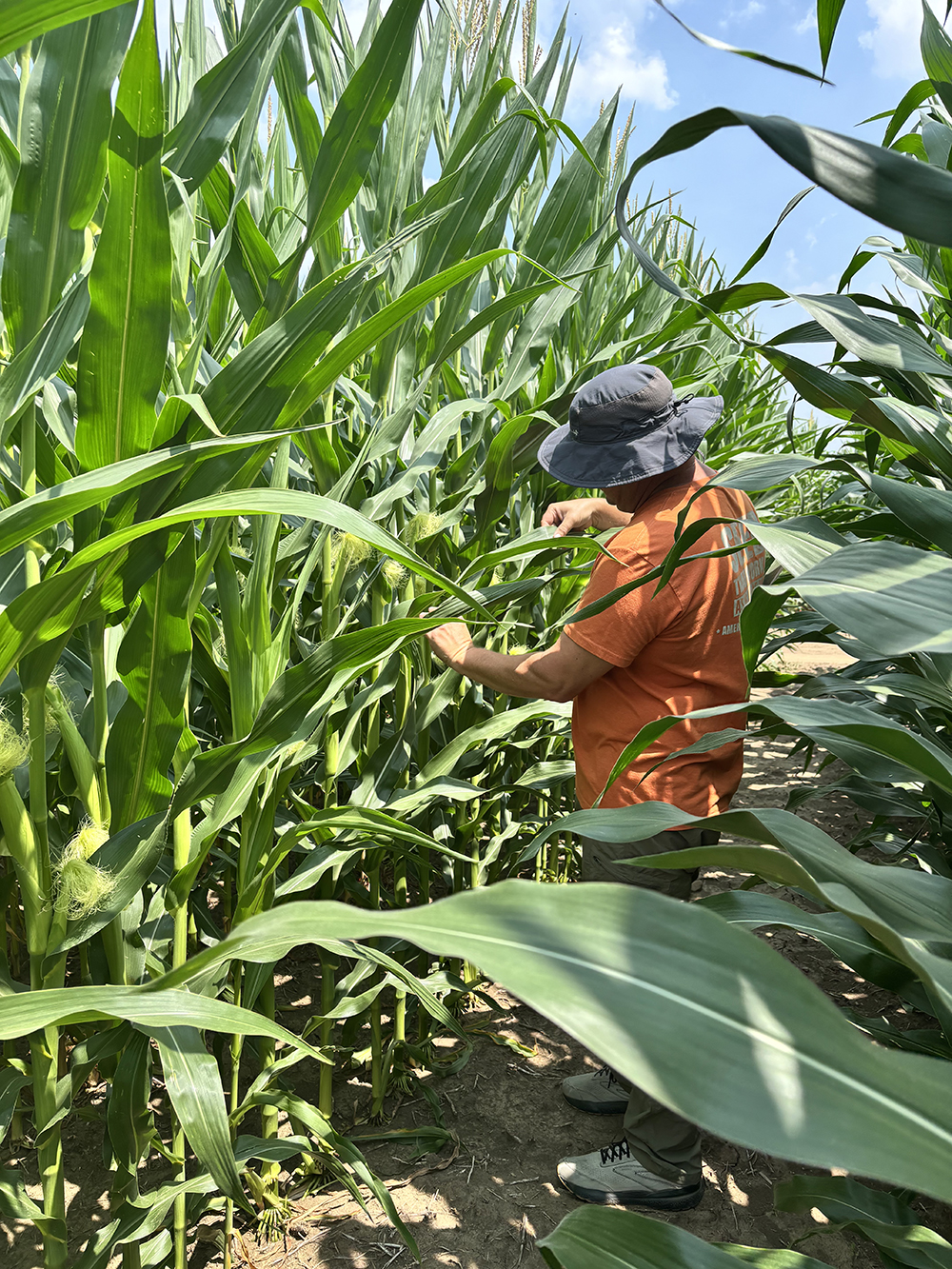
The growing season is entering one of its most important stages and the decisions we make now can have a lasting impact come harvest.
In this episode, Max is joined by Karl Bobholz, our Corn Product Manager, and Jim Torkelson, our Western Sales Lead, for a midseason report. Together, they discuss how this year’s planting conditions, weather patterns, and growing environment are shaping crops across the Midwest.
Fast Planting—Except Michigan!
Across the Midwest, planting was off to a fast start thanks to a stretch of great spring weather and big equipment getting the job done quickly. Every state was ahead of schedule except Michigan, which lagged slightly behind. Both corn and beans hit the ground in record time, but simultaneous planting of beans and corn might have led to some replanting in areas with cool, wet soil.
Weather: A Game of Extremes
Spring brought a mix of dry and wet conditions, and the weather continued to play a major role as the season progressed. Corn crops saw stretches of cool and hot weather, uneven emergence due to dry soils, and rapid vegetative growth outpacing root development. Recent heavy rains in some regions have led to further variability, with some fields getting up to seven inches of rain in a single night.
Spring brought a mix of dry and wet conditions, and the weather continued to play a major role as the season progressed.
Crop Progress and Challenges
- Corn: Generally looking good from the road, but nitrogen deficiency and uneven stands are showing up inside the fields. Fast mineralization this year means nutrients were released quickly, but heavy rains have moved them deeper into the soil, challenging root systems to catch up.
- Soybeans: Beans prefer warmer soils at planting. Cool temperatures and crusted soils led to some replanting, but beans are known to compensate for early setbacks better than corn.
Disease Watch
- Southern Rust: Not expected to be a major problem this year due to lack of inoculum and prevailing wind patterns.
- Tar Spot & Northern Leaf Blight: Present at low levels, especially in areas with irrigation or recent hail damage. Hot weather has slowed disease development, but vigilance is key.
- White Mold & SDS in Beans: White mold risk is up in fields with dense canopies and ample moisture. Sudden Death Syndrome (SDS) could appear in compacted, wet fields later in the season.
Insect activity has been relatively quiet, but oddities like slugs and swarms of June bugs have popped up in isolated areas.
Pest Pressure
Insect activity has been relatively quiet, but oddities like slugs and swarms of June bugs have popped up in isolated areas. No-till fields have seen more slug activity, while grub damage has drawn attention in some cornfields.
Actionable Insights for Growers
- Scout, Scout, Scout: Walking your fields is the best way to spot early issues and separate top performers from the rest. Look for nutrient deficiencies, disease symptoms, and pest pressures.
- Targeted Treatments: Apply fungicides only where economically justified—focus on diseases above the ear leaf and fields with hail or wind damage.
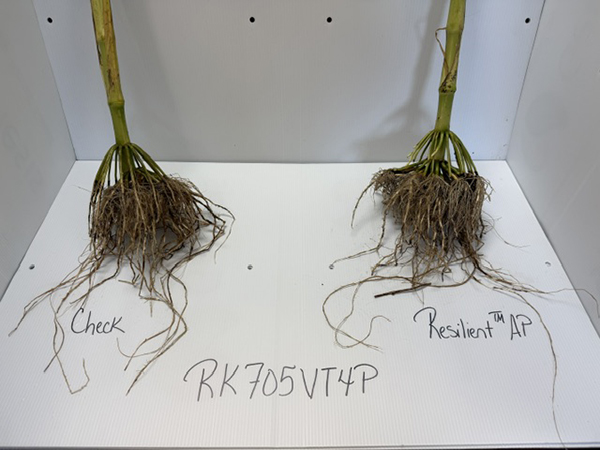
- Planter Innovations: New biological seed treatments like ResilientTM AP offer added protection against crown rots and can enhance emergence and vigor.
- Harvest Planning: Prioritize fields showing crown rot or white mold for early or late harvest, respectively, to preserve yield and prevent future problems.
Takeaways from the Field
Jim reminds growers: “You can’t fix a nitrogen deficiency with an overtop application if it’s a root problem. Economics matter—What’s my ROI on this?” Karl adds: “Growers are out there scouting the fields, understanding what the corn, the soybeans are telling them and managing to that – [those] are the ones that are separating themselves from being just good.”
You can’t fix a nitrogen deficiency with an overtop application if it’s a root problem...
Final Word
From nutrient availability and disease pressure to crop scouting and insect activity, Karl and Jim shared what they’re seeing in the field and what growers should be paying attention to as harvest approaches. Along the way, they shared practical recommendations for prioritizing field visits, evaluating risk, and making management choices that can maximize your return on investment. One thing is for sure: a successful crop isn’t just about the work you do from the tractor seat. It’s about walking your fields, understanding what your crop is telling you, and making informed decisions for a strong yield.
Thanks for reading! Tune in to the full episode, Renk Seeds of Innovation to hear the full update—and keep walking those fields!
Subscribe to the Renk Seeds of Innovation podcast and follow along as we celebrate the people in agriculture. You can find us on one of our social media channels: FB, Insta, X or LinkedIn. And, listen to the full episode on whichever streaming platform you prefer.
The Earfull May 22, 2026
Planting Progress Update
(based on USDA Crop Progress data for the week ending May 17, 2026)
A cooler spring has shaped the 2026 season, but it has not stopped progress across the Renk sales area.
USDA Crop Progress data for the week ending May 17, 2026, show that corn and soybean planting is mostly at or ahead of the 5-year average across both the northern region (MI, WI, MN, ND, SD) and the southern region (IN, IL, IA, NE). However, emergence is still catching up in some of the cooler areas.
This is an encouraging place to be as May turns toward June. The crop is largely in the ground, many acres are emerging on schedule, and the focus is now shifting from simply getting across fields to evaluating stands, watching early growth, and managing the first stresses of the growing season.
Cooler spring, strong finish
This spring has asked for patience. Across much of the Upper Midwest and Corn Belt, cooler temperatures slowed soil warmup and made emergence less uniform in some fields. Overall, the emergence has been surprisingly strong—just slow.
Even with this challenge, planting progress has been impressive. In the northern region, corn planting is ahead of the 5-year average in Minnesota, North Dakota, South Dakota, and Wisconsin, while Michigan is only modestly behind average. Soybean planting follows a similar pattern, with strong progress across most of the region and Michigan still working through a slightly slower pace.
The southern region has been especially efficient whenever conditions opened up. Indiana, Illinois, Iowa, and Nebraska are all ahead of their 5-year averages for both corn and soybean planting, which says a great deal about how quickly growers moved when the weather gave them a window.
The larger story is simple: despite a cool start, Renk growers did a great job getting the crop in the ground. That kind of planting progress helps preserve yield potential and gives fields the best possible chance to benefit from better growing conditions ahead.
Northern region update
The northern region includes some of the areas most affected by cool soils, but the planting pace still stands out. Minnesota, North Dakota, and South Dakota are all well ahead of their 5-year averages for both corn and soybean planting, while Wisconsin is also slightly ahead on both crops.
Michigan has been the main exception, running a bit behind average on both corn and soybean planting. Even so, the state is not dramatically off pace, and the gap is small enough that a few favorable days can quickly improve the overall picture.
Emergence in the North reflects that same weather story. Corn and soybean emergence is at or ahead of average in Minnesota, North Dakota, and South Dakota, while Michigan and Wisconsin are still a bit slower as cooler soils delay early growth.
For growers in the northern region, this is a good reminder that planting pace and emergence pace are not always the same thing. Fields that were planted on time may still need a careful look for uniformity, depth consistency, crusting issues, or seedling stress before they fully settle into the season.
Southern region update
The southern portion of the Renk sales area has made strong use of planting windows. Indiana, Illinois, Iowa, and Nebraska are all ahead of the 5-year average for corn planting, and all four states are also ahead of average for soybean planting.
That level of progress matters because it gives the crop a timely start. When planting is completed near or ahead of normal, management attention can shift sooner toward emergence checks, stand quality, herbicide performance, and early-season crop development rather than simply racing against the calendar.
Emergence numbers in the southern states are also encouraging. Corn emergence is at or above average across most of the region, and soybean emergence is also generally ahead of the 5-year average, suggesting that many acres are moving from planted to established in a favorable way.
This does not mean every field is perfect. A fast planting season can create sidewall issues, uneven depth, or localized ponding damage, so the next pass through the field remains important. Still, the regional data suggests the crop is entering the growing season from a strong position.
State-by-state snapshot (based on USDA Crop Progress data for the week ending May 17, 2026)
State | Corn planted | 5-year average | Corn emerged | 5-year average | Soybeans | 5-year average | Soybeans emerged | 5-year average |
Michigan | 47% | 52% | 3% | 15% | 37% | 46% | 2% | 13% |
Wisconsin | 62% | 59% | 13% | 18% | 54% | 50% | 9% | 13% |
Minnesota | 86% | 74% | 36% | 33% | 74% | 53% | 22% | 14% |
North Dakota | 58% | 40% | 13% | 9% | 41% | 28% | 5% | 2%. |
South Dakota | 81% | 65% | 22% | 21% | 59% | 46% | 10% | 8% |
Indiana | 67% | 57% | 42% | 29% | 67% | 50% | 42% | 23% |
Illinois | 75% | 73% | 46% | 46% | 74% | 63% | 44% | 35% |
Iowa | 88% | 82% | 46% | 43% | 80% | 68% | 28% | 25% |
Nebraska | 82% | 79% | 42% | 39% | 81% | 65% | 33% | 24% |
What to watch now
With most of the crop planted, the next two weeks become highly valuable. This is the time to check whether emergence is even, evaluate stand counts against expectations, and identify any fields where cool conditions, wet spots, crusting, or seedling stress may require closer management.
A few agronomic priorities stand out right now:
- Evaluate stand uniformity, not just population, because uneven emergence can reduce yield even when final stand counts look acceptable.
- Watch fields planted in marginal conditions for sidewall compaction, restricted roots, or inconsistent early vigor.
- Revisit low spots and variable soils first, since those are often the areas where cool spring conditions show up most clearly.
- Keep weed control timing tight, especially as fields move from planting season into rapid early vegetative growth.
Even with a cooler-than-normal start to spring, Renk growers across both the northern and southern regions made excellent planting progress and were timely getting the 2026 crop in the ground.
Now the season enters its next phase. Emergence, stand establishment, and early-season scouting will shape how well this fast planting pace turns into strong crop performance through the rest of the growing season.
References
- USDA National Agricultural Statistics Service, Crop Progress, week ending May 17, 2026. Accessed May 21, 2026. Available at:
https://www.nass.usda.gov/Publications/National_Crop_Progress/
The Earfull May 18, 2026
Early-Season Stands Set the Tone
Planting is nearing the finish line across much of the Upper Midwest, let’s look into stand evaluation. In both corn and soybeans, this is the point where visual impressions need to give way to counts, uniformity notes, and realistic replant economics. This issue focuses on three practical questions: how far scouting counts should run by row width, what stand is actually there, and when is a thin or uneven stand still worth keeping.
Row width | Distance to count |
15-inch | 34 ft 10 in |
20-inch | 26 ft 2 in |
22-inch | 23 ft 9 in |
30-inch | 17 ft 5 in |
Stand count chart: Use the 1/1000-acre method for fast, repeatable stand counts. Measure the row length below, count only viable plants, and multiply the count by 1,000 to estimate plants per acre.
Stand count scouting technique
- Do counts from four to six representative spots in a field, plus separate notes from obvious problem areas.
- Count only live plants with a realistic chance to continue developing; dead or clearly noncompetitive plants should not be included.
- Record skips, doubles, delayed plants, crusting, ponding, or sidewall issues while counting, because stand quality matters along with final population.
- Average the counts from representative areas and multiply by 1,000 to estimate the final stand per acre.
- Example calculation: In a 30-inch row, a scout counts 29 live corn plants in 17 feet 5 inches. That equals about 29,000 plants per acre. Four counts of 28, 30, 31, and 29 plants would average 29.5, or about 29,500 plants per acre.
Corn, the goal is simple: get every plant out of the ground at the same time and keep early stress from turning into uneven development. Uniform emergence matters because later plants act more like weeds than full contributors, and research summaries show meaningful yield loss when a portion of the stand lags by one to two leaf stages.
Corn is less forgiving than soybeans when emergence is uneven, so both stand and plant-to-plant uniformity should drive the decision. Replant tables are built around the trade-off between reduced current stand and delayed replant yield potential.
Final stand | Before May 10 | May 10–20 | After May 20 |
24,000+ | Keep | Keep | Keep |
20,000–23,999 | Keep if uniform | Consider economics | Usually keep |
16,000–19,999 | Compare yield vs. delay | Borderline | Often keep |
Below 16,000 | Strong replant case | Case-by-case | Late replant risk |
The matrix is built on a target planting rate of 32,500 so if you have lower planting targets, this matrix would need to be lower based on your planting rate.
Corn scouting reminders
- Uneven emergence can cost yield even when total population looks acceptable.
- Dig plants in uneven areas to check for sidewall compaction, crusting, seed furrow issues, or early root restriction.
- Replant decisions should be based on surviving stand, uniformity, and realistic replant date, not appearance from the road.
Soybean stand review should be top of mind this week because many early-planted fields are now emerging unevenly after cool conditions, surface crusting, and scattered ponding events. The first question is not whether the stand is perfect, but whether it is uniform, healthy, and above the practical threshold where replanting usually fails to return enough yield to pay for itself. Use stand counts from several representative areas and only count live plants that are likely to continue developing. The same 1/1000-acre method works for soybeans in the chart from the earlier section, but acceptable final stands are often lower because soybeans compensate through branching.
Soybean replant decisions should center on live stand, spacing, and date rather than chasing a perfect-looking field. Early-planted soybean stands can often be left at lower populations than most growers expect, particularly when plants are healthy and gaps are limited.
Final stand | Before May 15 | May 15–31 | June |
100,000+ | Keep | Keep | Keep |
75,000–99,999 | Keep if uniform | Keep | Keep |
50,000–74,999 | Consider gaps and vigor | Usually keep | Keep |
Below 50,000 | Replant or fill-in case | Borderline economics | Late replant often loses |
Soybean scouting reminders
- Desired stands may be near 100,000 plants per acre, but uniform stands near 70,000 to 75,000 can still retain most yield potential.
- Early-planted fields below 75,000 plants per acre deserve closer review, while late-May and June fields often have lower replant thresholds around 50,000 to 60,000 plants per acre.
- Large dead gaps, seedling disease, ponding, and uneven emergence matter more than cosmetic thinness alone.
References
- Iowa State University Extension and Outreach. Tables for Determining Plant Populations. Accessed May 13, 2026
.https://crops.extension.iastate.edu/files/icm/TablesforDeterminingPlantPopulations.pdf - Iowa State University Extension and Outreach. Corn replant checklist and Soybean Replant Checklist. Accessed May 13, 2026.
https://crops.extension.iastate.edu/encyclopedia/corn-replant-checklist and
https://crops.extension.iastate.edu/encyclopedia/soybean-replant-checklist - Crop Protection Network. Crop Scouting Basics for Corn and Soybean; Michigan State University Extension. Assessing soybean stands. Accessed May 13, 2026.
https://cropprotectionnetwork.org/web-books/crop-scouting-basics-for-corn-and-soybean and https://www.canr.msu.edu/news/assessing-soybean-stands
The Earfull April 27, 2026
Planting Into Marginal Conditions
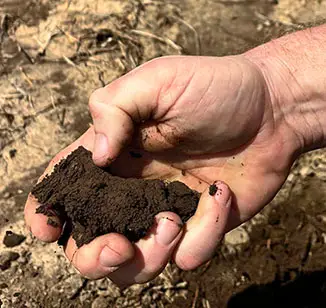
The planting window always tempts growers to push. The best risks are the ones that preserve stand establishment, not the ones that simply move the calendar ahead. University extension guidance consistently points to soil fit, short-term temperature trend, and emergence uniformity as the main factors that separate a smart early push from a preventable stand.
Corn can justify some early-planted risk when:
- Seed-zone soil temperature is at or near 50°F.
- The forecast is warming.
- The field is fit enough to avoid sidewall smearing or cloddy seedbeds.
In dry conditions, moving seed a bit deeper to reach uniform moisture can be worthwhile.
The risk is usually not worth planting into wet soils, planting just ahead of a cold rain, or planting in rough conditions causing variable seed depth. Corn is especially vulnerable during the first 24 to 48 hours after planting because cold water uptake can trigger imbibitional chilling, leading to weak or abnormal seedlings before the crop ever reaches the surface.
A practical way to frame corn decisions is simple:
- Take the risk when soils are fit, moisture is uniform, and temperatures are expected to hold or rise.
- Don’t take the risk when the field is tacky, sidewalls smear, or a cold rain is likely right after planting.
- Protect yield by chasing uniform emergence more than by chasing the earliest possible date.
Soybeans often reward timely early planting, but only when the first day after planting favors warm water uptake rather than cold shock. Iowa State still recommends planting soybeans into warm soils when temperatures are not expected to decrease during the first 24 hours. This is because the seed is most vulnerable during the first 12 to 24 hours of water uptake.
The risk potentially worth taking in soybeans is planting early into a fit field with a stable forecast, even if the calendar date feels aggressive. The risk typically not worth taking is planting into cool, wet, or saturated ground where crusting and oxygen stress can nearly wipe out emergence, especially in low areas or fields with uneven drying.
For both crops, the main question is not “Can the planter run?” but “Will the stand emerge evenly?” Corn pays a bigger penalty for uneven emergence, while soybeans generally tolerate stand variability better — unless gaps become large or emergence failures are severe.
Early Emergence Expectations
Once seed is in the ground, the next job is to separate patience from problems. Cool conditions slow emergence naturally. Scouting should focus on whether plants are progressing normally, uniformity of delays, and if symptoms point to crusting, chilling, disease, or seed-zone variability.
In corn, early emergence should be judged on both timing and uniformity. Purdue’s work shows yield loss grows when emergence spreads out. Full stands containing plants delayed by about 1.5 weeks lose roughly 6 to 8 percent, and delays of about 3 weeks become much more costly, especially when many plants are late.
Scout corn fields for:
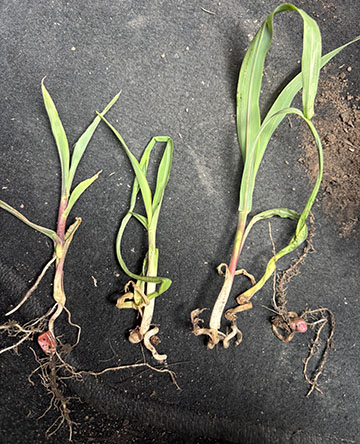
- Uneven height or leaf stage across the row, which often points to variable moisture, temperature, or seed placement.
- Corkscrewed mesocotyls or underground leafing out after cold stress.
- Plants trapped below a crusted surface, especially after hard rain on worked ground.
- Open seed furrows, sidewall compaction, or clod-related skips that trace back to planting into wet soils.
- A useful rule in corn is that uniform, slower emergence is usually less damaging than patchy emergence. If the whole field is slow because temperatures stayed cool, patience is often warranted; if neighboring plants are emerging far apart in stage, competition begins early and yield risk rises.
Soybeans deserve a different lens. Iowa State notes soybean cold injury can reduce vigor or kill seed before emergence, but soybean stands often tolerate some unevenness better than corn unless plant loss creates large holes.
Scout soybean fields for:
- Missing plants tied to seed death before emergence in cold, wet soils.
- Pale seedlings, slow hypocotyl pull, or emergence blocked by crusting.
- Swollen, weak, or rotted seedlings that suggest disease pressure in saturated conditions.
- Large gaps, especially those greater than about 2 feet, as this could lead to higher pressure later in the year.
Soybean emergence evaluation should emphasize surviving stand and gap pattern more than perfect visual uniformity. Iowa State notes soybean emergence uniformity very rarely causes enough yield loss by itself to justify replanting. Instead, the key is to confirm that enough healthy plants are present and the stand can canopy and compete.
Scouting priority for both crops:
Dig plants rather than guessing from the road. The first pass should check seed depth, moisture pattern, mesocotyl or hypocotyl condition, crusting, and whether the problem is random or tied to a soil type, tillage pass, residue band, or low spot.
Sources
- University of Minnesota Extension. “Strategies for Successful Corn Planting.” Accessed 2026.
https://extension.umn.edu/corn-planting/strategies-successful-corn-planting - Iowa State University Extension and Outreach – Integrated Crop Management. “Stand Establishment Critical for Early Planted Corn and Soybean.” Accessed 2026. https://crops.extension.iastate.edu/post/stand-establishment-critical-early-planted-corn-and-soybean
- Purdue University Extension. “Effects of Uneven Seedling Emergence in Corn (NCH-36).” Accessed 2026.
https://www.extension.purdue.edu/extmedia/nch/nch-36.html
The Earfull April 20, 2026
Early Season Insects—What to Look For
Planting season moves fast. By the time a stand problem is obvious, the window to act — or to explain it — has already closed. Early-season insects are one of the most common causes of uneven emergence, skips, and replant decisions, and they’re easy to miss if you’re not scouting at the right time.
Risk isn’t tied to one type of spring. Cool, wet soils slow germination and leave seeds in the ground longer, giving soil-dwelling pests more time to feed. But warm soils with heavy crop residue, manure applications, or recently terminated cover crops create their own risk by drawing egg-laying insects and supporting larval populations. Both scenarios show up regularly across the Renk sales area. Walking fields at or shortly after emergence — not just at canopy closure — is when these problems are catchable and explainable. Let’s review the key pest offenders:
Seedcorn Maggot (Corn and Soybeans)
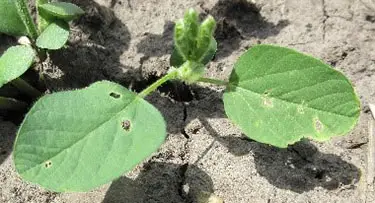
Seedcorn maggot is the larva of a small fly — pale yellow-white, legless, about ¼ inch long. Larvae feed directly on germinating seeds and young shoots before the plant ever breaks ground. Fresh organic matter is the main attractant. Fields with heavy residue, recent manure, incorporated cover crops, or freshly tilled green material carry the highest risk. Cool, wet soils compound the problem by slowing germination and extending the window larvae have to feed.
In the field, look for seeds that are hollowed out or show no viable shoot or root development. You’ll often find seedlings that started to emerge and then died at or just below the soil surface. Gaps and skips that don’t match planter performance data are a telltale sign, particularly in low-lying areas, field edges near manure application zones, or anywhere a cover crop was terminated late.
Wireworm (Corn and Soybeans)
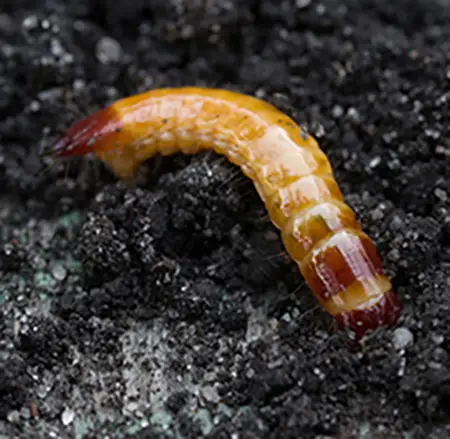
Wireworms are the larvae of click beetles — hard, shiny, orange-brown, and cylindrical, almost wire-like to the touch. They spend multiple years in the soil and feed on seeds and below-ground plant tissue. Sod ground is the classic red flag: former pasture, fields following small grains or perennial grasses, or any ground that’s been in long-term grass cover. First-year corn or soybeans after sod is the highest-risk scenario you’ll encounter.
Stand loss from wireworm tends to be patchy and irregular — not clean row skips, but odd sections or scattered holes in the field. Seeds will show entry holes or be hollowed out with the shoot or radicle chewed off. To confirm, dig 6 to 12 inches deep in problem areas; early in the season when soils are still cool, wireworms concentrate in the top few inches. Stunted, wilted, or dead seedlings where the underground stem is damaged, but the plant never fully emerged are a reliable indicator.
Black Cutworm (Primarily Corn; Occasionally Soybeans)
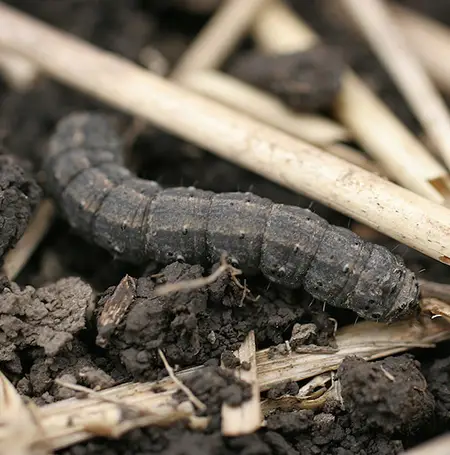
Black cutworm moths don’t overwinter in most of the Renk sales area — they migrate north on spring storm systems. Fields with winter annual weeds, heavy surface residue, or recently terminated cover crops are higher risk because they attract egg-laying moths. Corn from VE through V5 is the primary target. Soybeans can occasionally be clipped in a heavy year, but this is mainly a corn problem.
Watch for wilted or cut-off plants at or just below the soil surface, often in the first few rows from field edges or in weedy areas. Damage shows up in clusters or patches, not uniformly across the field. Before full cutting begins, you may see small, round feeding holes in leaves — that’s your early warning. When you find damage, dig in moist soil near the affected plants and look for the caterpillar itself: dark gray to black, curls into a C-shape when disturbed.
In soybeans, if pressure is unusually high, check for clipped stems or leaf feeding on early-emerged plants along field edges or in areas with residue. It’s uncommon, but worth a look in high-pressure years.
Quick Risk Overview:
No single field type has zero risk. The combination of field history — sod, cover crops, manure — residue levels, weed pressure, and spring weather determines where problems concentrate. Cool springs push seedcorn maggot and wireworm risk up. Warm springs with weedy fields and migrating storm fronts elevate black cutworm. Many fields carry more than one risk factor.
Take Home:
- Walk fields at emergence. Target fields with manure, high residue, cover crop history, sod ground, or known weed pressure first — these are your highest-risk acres.
- Dig before you diagnose. Skips and uneven emergence have many causes. Pull seeds and seedlings from problem areas and look for physical damage before attributing stand loss to cold stress or planter issues.
- Document what you find. Note field history, soil conditions, pest species observed, and estimated stand loss.
Early planting into cold soils increases seedcorn maggot and wireworm exposure. Late cover crop termination increases all three pest risks.
Sources:
- University of Wisconsin–Madison Extension — ipcm.wisc.edu
- Iowa State University Extension — crops.extension.iastate.edu
- Michigan State University Extension — canr.msu.edu/ipm
Precision Farming in 2026: How Precision Spraying and Planting Can Cut Costs and Save Time
Season 1, Episode 12
Precision Farming in 2026: How Precision Spraying and Planting
Can Cut Costs and Save Time
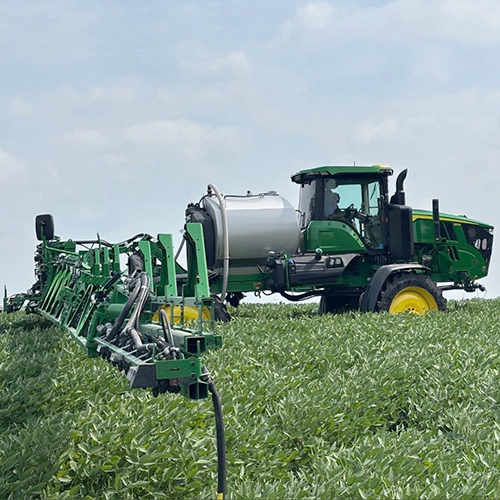
Precision technology in agriculture is rapidly changing how growers manage inputs, labor, and efficiency on every acre. In this episode, Max Renk sits down with Matt Greenough and Holden Cauffman, two farmers in the Midwest, to discuss their experience with adding precision tools to their own operations.
Matt brings us along as he recaps his first full season using John Deere’s See & Spray™ technology, including how camera-based weed detection, individual nozzle control, and automation features delivered an average 68% reduction in chemical usage on his farm. Holden dives into how his Precision Planting SymphonyNozzle™ setup, turn compensation, and boundary mapping helped him reduce overlap, increase accuracy, and save time in the field.
Together, Max, Matt, and Holden break down several aspects of precision farming. From how camera-guided spot spraying works in corn and soybeans to the ROI potential of precision spraying systems, they uncover the realities of how modern technology is applied on real farms. At Renk Seed, we’re passionate about finding innovations that deliver real, measurable value in the field. This conversation highlights how precision technology helps farmers reduce input costs and operate more confidently in today’s agricultural landscape.
At Renk Seed, we’re passionate about finding innovations that deliver real, measurable value in the field.
Real-World Results
On both farms, the impact is clear: big chemical savings and major time savings. Matt is seeing around 68% less chemical use on post-emerge passes while still keeping fields clean, plus far fewer refills and less labor. Holden has almost eliminated overlap, applies more consistent rates on curves and hills, and knows that if he mixes for 50 acres, he actually sprays 50 acres—this really pays off in odd-shaped and challenging fields.
Unforeseen Benefits
The benefits go well beyond spraying. With mapped boundaries and waterways, autosteer, and turn automation, both farms are running more efficiently across planting, spraying, and harvest. They’re seeing less crop damage, less operator stress, and even yield bumps—Matt’s checks showed about 3 extra bushels per acre where See & Spray™ was used, likely because crops aren’t stressed by unnecessary herbicide.
...precision spraying and automation help them cover more acres, in less time, with fewer people—while keeping fields cleaner and crops healthier.
Economics: Do the Numbers Pencil Out?
While subscription and hardware costs are real, both growers say the technology pays for itself through chemical savings, reduced labor, and potential yield increases. Looking ahead, they’re excited about what’s coming next—like AI cameras that can handle stand counts, rock mapping, variable-rate herbicide, and dual-boom systems that combine residual and targeted sprays. Their bottom line: precision spraying and automation help them cover more acres, in less time, with fewer people—while keeping fields cleaner and crops healthier.
Already using precision technology on your fields? Considering adopting these tools? We’d love to hear from you to share experiences and find answers to questions. You can contact us on one of our social media channels: FB, Insta, X or LinkedIn. Listen to the full episode on whichever streaming platform you prefer or right here on our website.


