Planting Into Marginal Conditions
The planting window always tempts growers to push. The best risks are the ones that preserve stand establishment, not the ones that simply move the calendar ahead. University extension guidance consistently points to soil fit, short-term temperature trend, and emergence uniformity as the main factors that separate a smart early push from a preventable stand.
Corn can justify some early-planted risk when:
- Seed-zone soil temperature is at or near 50°F.
- The forecast is warming.
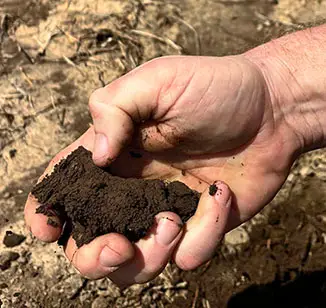
- The field is fit enough to avoid sidewall smearing or cloddy seedbeds.
In dry conditions, moving seed a bit deeper to reach uniform moisture can be worthwhile.
The risk is usually not worth planting into wet soils, planting just ahead of a cold rain, or planting in rough conditions causing variable seed depth. Corn is especially vulnerable during the first 24 to 48 hours after planting because cold water uptake can trigger imbibitional chilling, leading to weak or abnormal seedlings before the crop ever reaches the surface.
A practical way to frame corn decisions is simple:
- Take the risk when soils are fit, moisture is uniform, and temperatures are expected to hold or rise.
- Don’t take the risk when the field is tacky, sidewalls smear, or a cold rain is likely right after planting.
- Protect yield by chasing uniform emergence more than by chasing the earliest possible date.
Soybeans often reward timely early planting, but only when the first day after planting favors warm water uptake rather than cold shock. Iowa State still recommends planting soybeans into warm soils when temperatures are not expected to decrease during the first 24 hours. This is because the seed is most vulnerable during the first 12 to 24 hours of water uptake.
The risk potentially worth taking in soybeans is planting early into a fit field with a stable forecast, even if the calendar date feels aggressive. The risk typically not worth taking is planting into cool, wet, or saturated ground where crusting and oxygen stress can nearly wipe out emergence, especially in low areas or fields with uneven drying.
For both crops, the main question is not “Can the planter run?” but “Will the stand emerge evenly?” Corn pays a bigger penalty for uneven emergence, while soybeans generally tolerate stand variability better — unless gaps become large or emergence failures are severe.
Early Emergence Expectations
Once seed is in the ground, the next job is to separate patience from problems. Cool conditions slow emergence naturally. Scouting should focus on whether plants are progressing normally, uniformity of delays, and if symptoms point to crusting, chilling, disease, or seed-zone variability.
In corn, early emergence should be judged on both timing and uniformity. Purdue’s work shows yield loss grows when emergence spreads out. Full stands containing plants delayed by about 1.5 weeks lose roughly 6 to 8 percent, and delays of about 3 weeks become much more costly, especially when many plants are late.
Scout corn fields for:
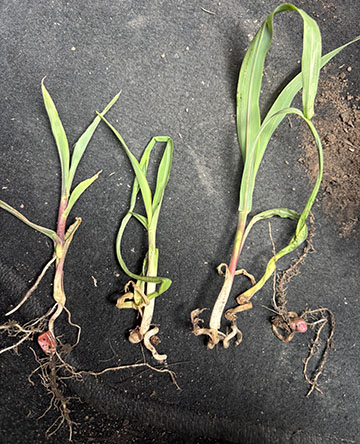
- Uneven height or leaf stage across the row, which often points to variable moisture, temperature, or seed placement.
- Corkscrewed mesocotyls or underground leafing out after cold stress.
- Plants trapped below a crusted surface, especially after hard rain on worked ground.
- Open seed furrows, sidewall compaction, or clod-related skips that trace back to planting into wet soils.
- A useful rule in corn is that uniform, slower emergence is usually less damaging than patchy emergence. If the whole field is slow because temperatures stayed cool, patience is often warranted; if neighboring plants are emerging far apart in stage, competition begins early and yield risk rises.
Soybeans deserve a different lens. Iowa State notes soybean cold injury can reduce vigor or kill seed before emergence, but soybean stands often tolerate some unevenness better than corn unless plant loss creates large holes.
Scout soybean fields for:
- Missing plants tied to seed death before emergence in cold, wet soils.
- Pale seedlings, slow hypocotyl pull, or emergence blocked by crusting.
- Swollen, weak, or rotted seedlings that suggest disease pressure in saturated conditions.
- Large gaps, especially those greater than about 2 feet, as this could lead to higher pressure later in the year.
Soybean emergence evaluation should emphasize surviving stand and gap pattern more than perfect visual uniformity. Iowa State notes soybean emergence uniformity very rarely causes enough yield loss by itself to justify replanting. Instead, the key is to confirm that enough healthy plants are present and the stand can canopy and compete.
Scouting priority for both crops:
Dig plants rather than guessing from the road. The first pass should check seed depth, moisture pattern, mesocotyl or hypocotyl condition, crusting, and whether the problem is random or tied to a soil type, tillage pass, residue band, or low spot.
Sources
- University of Minnesota Extension. “Strategies for Successful Corn Planting.” Accessed 2026.
https://extension.umn.edu/corn-planting/strategies-successful-corn-planting - Iowa State University Extension and Outreach – Integrated Crop Management. “Stand Establishment Critical for Early Planted Corn and Soybean.” Accessed 2026. https://crops.extension.iastate.edu/post/stand-establishment-critical-early-planted-corn-and-soybean
- Purdue University Extension. “Effects of Uneven Seedling Emergence in Corn (NCH-36).” Accessed 2026.
https://www.extension.purdue.edu/extmedia/nch/nch-36.html