The Earfull May 11, 2026
GDUs
Planting progress is rapidly moving forward even with the cold and windy conditions. This week, let’s focus on growing degree unit (GDU) tracking and early nitrogen planning. Corn development does not move by calendar date alone; it moves by heat accumulation, so the best early-season management starts with matching field observations to GDU totals and then using that information to stay ahead of nutrient demand.
The formula for GDUs: take the daily high plus the daily low, divide by two, then subtract 50. For corn, the high is capped at 86°F and the low is floored at 50°F because growth does not keep accelerating above 86°F and development slows sharply below 50°F. A simple example helps. If the high is 64°F and the low is 50°F, the average is 57. This would be a 7 GDUs day. If the high is 92°F and the low is 46°F, the adjusted values become 86 and 50, so the crop gains 18 GDUs rather than 19. That keeps the number tied more closely to how corn develops.
Emergence generally occurs after about 100 to 120 GDUs, and from emergence through about V10, leaf collars typically appear at roughly one new stage every 82 to 85 GDUs. That means GDU tracking can be turned into a practical field forecast: once a field is planted, growers can estimate when it should emerge, when it should reach key vegetative stages, and when management windows such as post herbicide or sidedress nitrogen are approaching.
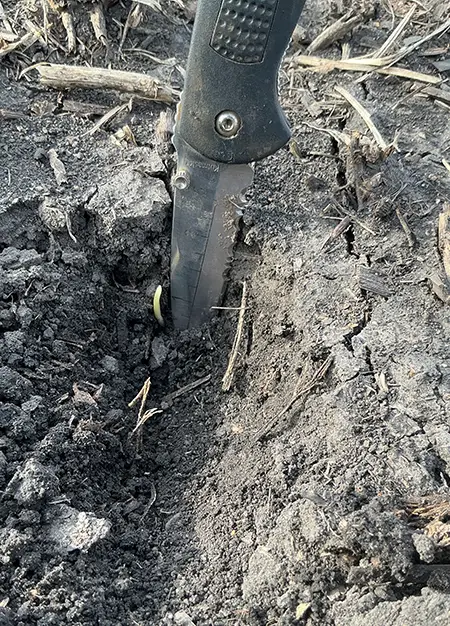
This matters most in uneven springs. Cool nights, dry topsoil, crusting, and variable residue can make neighboring fields look different even when they were planted within a day or two of each other. In those situations, GDU totals help separate true agronomic delay from visual noise. A field that has not yet accumulated enough heat for the next stage may simply be behind thermally, not necessarily in trouble.
A simple way to use GDU tracking this month is to pair three checks together. First, record planting date by field. Second, track cumulative GDUs from planting. Third, confirm actual stage by leaf collar, not plant height. Height can change fast with weather, but collar stage is the more reliable way to line up crop development with input timing. In practical terms, if a field has accumulated around 120 GDUs after planting, emergence should be close. If it has moved well beyond that and stand is still uneven, that is the time to dig, inspect seedling health, and look for moisture, crusting, insect, or disease issues rather than guessing from the road.
The next key point is that early vegetative stages set up later opportunity. Corn progresses rapidly once conditions turn favorable. Under good conditions, a young plant can unfurl a new leaf every 3 to 4 days, and later in vegetative growth leaves can appear every 2 to 3 days. That pace is why weekly scouting needs to become more disciplined in May. Fields can move from emergence to the start of rapid uptake windows in a surprisingly short stretch, especially when temperatures run slightly above average or maybe stretch out with colder than average conditions like we are seeing this year.
Tracking GDUs also improves communication across farms and teams. Saying a field is “just starting” is vague. Saying it was planted April 28, has accumulated roughly 190 GDUs, and is at V1 to V2 gives a clearer read on what should happen next and whether the crop is on pace. That kind of discipline helps prioritize scouting, herbicide timing, replant discussions, and fertility plans.
Why Sidedress Nitrogen May Deserve a Closer Look in 2026
With fertilizer costs under pressure again in 2026, sidedress nitrogen deserves renewed attention to protect both nitrogen efficiency and crop response.
In years like this, the question is not only how much nitrogen to apply, but when to put the bulk of it at risk. Wisconsin guidance has long shown that interest in sidedress nitrogen rises when fertilizer costs are high because delayed application can improve nitrogen effectiveness and help avoid some losses before the crop needs the full supply. That idea lines up well with how corn grows. Corn begins rapid growth and nitrogen uptake around the V5 to V6 stage, making the V4 to V6 period a practical target for many sidedress operations. University of Minnesota guidance similarly points to V4 to V8 as the best timing window, with sidedress no later than about V8 to V9 when a modest starter or preplant nitrogen program has already carried the crop.
The value of sidedressing is straightforward. Nitrogen placed months ahead of peak use can be vulnerable to loss from wet soils, denitrification, leaching, or surface volatilization, depending on source and conditions. By moving a meaningful share of total nitrogen closer to the crop’s demand curve, growers may reduce exposure to those loss pathways and keep more applied nitrogen available when the plant is entering rapid uptake.
This strategy is not a fit for every acre or every operation. It requires labor, equipment, timeliness, and a willingness to scout. But it can make sense where springs are wet, where soils are more prone to losses, where planting windows compress fertilizer decisions, or where a grower wants flexibility to adjust rates after seeing stand establishment and yield potential.
Source and placement still matter. Urea and UAN (28% or 32%) are common sidedress sources, but surface-applied materials can be exposed to volatilization, especially when hot and dry conditions follow application without rainfall. Where UAN is knifed in and the slot closes, a urease inhibitor is often less necessary; where urea or UAN remains on the surface, rainfall timing and inhibitor use become more important considerations. That means sidedress is not automatically efficient just because it is later. It works best when timing, source, placement, and weather are all considered together.
The 2026 takeaway is practical. If fertilizer is expensive, every pound needs a job. Tracking corn by GDU and leaf collar stage helps identify when the crop is approaching rapid nitrogen demand, and sidedressing can be one of the better tools for matching supply with that demand. Done well, it can improve efficiency, preserve flexibility, and reduce the amount of nitrogen exposed to early-season loss before the crop is ready to use it.
References
- Nielsen, R.L., Purdue University Extension. 2019. Predict Leaf Stage Development in Corn Using Thermal Time
- Bundy, L.G., Andraski, T.W., and Powell, J.M., Wisconsin Soil Science Extension. January 14, 2013.
Sidedressing Nitrogen: Useful on All Soils? - Kaiser, D.E. and Fernandez, F.G., University of Minnesota Extension. March 6, 2023.
Split-applying nitrogen for corn: Three keys for successful sidedress applications
The Earfull May 4, 2026
Cold Soils, Slow GDUs, and Frost
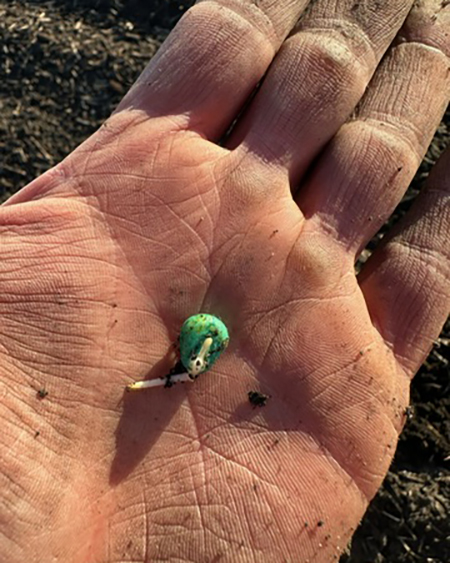
The last week has not given us many GDUs, and that changes the conversation for a lot of fields. Instead of focusing only on frost burn to emerged plants, the bigger concern in many acres is seed and seedlings sitting in cold soils, waiting for heat. Corn emergence is strongly tied to temperature, and Extension guidance shows that corn typically needs about 90 to 120 GDUs from planting to emergence, with around 125 GDUs often used as a practical benchmark in the Upper Midwest. Residue, fine-textured soils, deeper planting depth, crusting, and cool seed-zone conditions can all stretch that window further.
That matters this spring because many planted fields likely are not far enough along to have much exposed tissue yet. A lot of the risk is still below ground. Fields planted earliest, fields on lighter ground, or fields with warmer seedbeds may have some emerged corn or soybeans, but broad acres are more likely sitting in a delayed emergence pattern than in a true frost-leaf-burn situation. That is why this week is a good time to remind us that a slow start does not automatically equal a failed start.
For fields that have not emerged, the first step is to dig, not guess. Check seed and seedlings in several spots across the field, especially where soils differ. Healthy seedlings should still be firm, light colored, and progressing normally. Trouble signs include seed that is soft, discolored, or leaking; mesocotyls or hypocotyls that are brown, water-soaked, or collapsed; and seedlings that are twisted, leafed out underground, or simply not progressing toward emergence. Cold conditions do not always kill a stand, but they do raise the odds of uneven emergence, wider variation in plant size, and more plant-to-plant competition later in the season.
For acres that emerged, crop stage is everything. In corn, leaf tissue may turn brown or black after a frost and still not mean the plant is dead. Corn’s growing point stays below ground until about V5, which gives the crop a level of protection from simple frost. If temperatures fall to truly lethal levels, around 28 degrees or lower for several hours, injury can move beyond leaf tissue and affect the growing point even though it remains below the soil surface. That is the difference between cosmetic injury and real stand loss.
Soybeans are more exposed once emerged because their growing points are above ground much earlier. Frost injury to cotyledons and upper tissue can be more serious in beans than in corn, but soybean recovery is still possible if living buds remain at nodes above the point of fatal injury. If freeze damage extends below the cotyledons, that plant usually will not recover. This is why soybeans often require more careful plant-by-plant inspection after a cold event instead of a quick visual estimate from the field edge.
The main message for this week is straightforward. A lot of fields have not had enough heat to be judged from the road. Dig seedlings, know your stage, and give frosted acres a few days before deciding. Slow emergence is frustrating, but slow does not always mean dead. In many cases, the best management choice is not speed, but patience and accurate scouting.
Pre-Emerge Weed Control
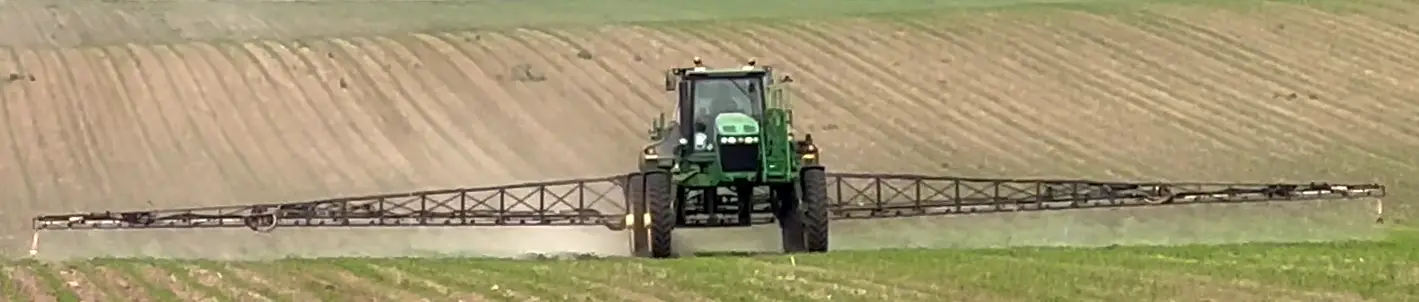
In a spring with slow GDUs and uneven crop emergence, pre-emergence (PRE) herbicides become even more important. Weeds do not need a fully developed crop to create problems, and they often take advantage of slow-starting corn and soybeans before the crop can compete. A strong PRE herbicide program remains one of the most important tools for managing weeds and protecting soybean yield potential, especially as resistance to key post-emergence chemistries continues to spread.
The weather forecast is a major part of whether a PRE program performs the way it should. PRE herbicides generally need rainfall for activation so the active ingredient can move into the soil zone where weed seeds germinate. Most need about 0.25 to 1 inch of rainfall to activate soil-applied herbicides. Many products can remain effective on the soil surface for about 7 to 10 days, with some lasting up to 14 days before activation.
On the other side, too much rain can also create issues. Heavy rainfall near crop emergence can increase the chance of crop response, especially in soybeans and with products or soil conditions already prone to temporary injury. Cool, wet conditions can increase the chance of early-season soybean response from some PRE herbicides, particularly on coarse-textured soils with low organic matter or higher pH. Even though soybeans often recover from minor injury without lasting yield loss, this is still a good reminder that product choice, soil type, and timing all matter.
That is why PRE timing should be connected to both planting date and the short-term forecast. In a cool spring like this one, there may be a little more flexibility in some fields because the crop is moving slowly. But that flexibility can disappear quickly once a warmer stretch arrives. A field that looked several days away from emergence can move faster than expected once soils warm, and that changes both crop safety considerations and the value of getting the herbicide applied before the next activating rain.
In a year like this, good weed control will come from matching the PRE program to the field by field forecast. Put the strongest focus on fields most likely to emerge quickly or fields with the toughest weed history. Then follow with a timely post pass rather than expecting the PRE to solve the entire season by itself. In short, a slow spring does not reduce the importance of pre-emerge herbicides. It probably increases it.
Sources
- Purdue University Agronomy. “Early Season Frost & Low Temperature Damage to Corn and Soybean.” Accessed April 30, 2026.
https://www.agry.purdue.edu/ext/corn/news/articles.02/frost_freeze-0520.html - University of Nebraska–Lincoln CropWatch. “Growing Degree Units and Corn Emergence.” Accessed April 30, 2026
https://cropwatch.unl.edu/growing-degree-units-and-corn-emergence/ - University of Minnesota Extension. “Start clean, stay clean: Why pre-emergence herbicides are essential for soybean weed control in Minnesota.” Accessed April 30, 2026. https://blog-crop-news.extension.umn.edu/2026/04/start-clean-stay-clean-why-pre.html
The Earfull April 27, 2026
Planting Into Marginal Conditions
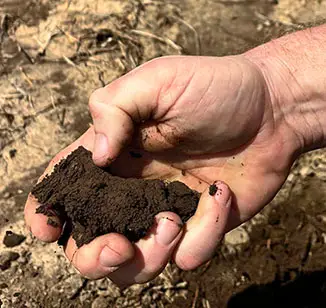
The planting window always tempts growers to push. The best risks are the ones that preserve stand establishment, not the ones that simply move the calendar ahead. University extension guidance consistently points to soil fit, short-term temperature trend, and emergence uniformity as the main factors that separate a smart early push from a preventable stand.
Corn can justify some early-planted risk when:
- Seed-zone soil temperature is at or near 50°F.
- The forecast is warming.
- The field is fit enough to avoid sidewall smearing or cloddy seedbeds.
In dry conditions, moving seed a bit deeper to reach uniform moisture can be worthwhile.
The risk is usually not worth planting into wet soils, planting just ahead of a cold rain, or planting in rough conditions causing variable seed depth. Corn is especially vulnerable during the first 24 to 48 hours after planting because cold water uptake can trigger imbibitional chilling, leading to weak or abnormal seedlings before the crop ever reaches the surface.
A practical way to frame corn decisions is simple:
- Take the risk when soils are fit, moisture is uniform, and temperatures are expected to hold or rise.
- Don’t take the risk when the field is tacky, sidewalls smear, or a cold rain is likely right after planting.
- Protect yield by chasing uniform emergence more than by chasing the earliest possible date.
Soybeans often reward timely early planting, but only when the first day after planting favors warm water uptake rather than cold shock. Iowa State still recommends planting soybeans into warm soils when temperatures are not expected to decrease during the first 24 hours. This is because the seed is most vulnerable during the first 12 to 24 hours of water uptake.
The risk potentially worth taking in soybeans is planting early into a fit field with a stable forecast, even if the calendar date feels aggressive. The risk typically not worth taking is planting into cool, wet, or saturated ground where crusting and oxygen stress can nearly wipe out emergence, especially in low areas or fields with uneven drying.
For both crops, the main question is not “Can the planter run?” but “Will the stand emerge evenly?” Corn pays a bigger penalty for uneven emergence, while soybeans generally tolerate stand variability better — unless gaps become large or emergence failures are severe.
Early Emergence Expectations
Once seed is in the ground, the next job is to separate patience from problems. Cool conditions slow emergence naturally. Scouting should focus on whether plants are progressing normally, uniformity of delays, and if symptoms point to crusting, chilling, disease, or seed-zone variability.
In corn, early emergence should be judged on both timing and uniformity. Purdue’s work shows yield loss grows when emergence spreads out. Full stands containing plants delayed by about 1.5 weeks lose roughly 6 to 8 percent, and delays of about 3 weeks become much more costly, especially when many plants are late.
Scout corn fields for:
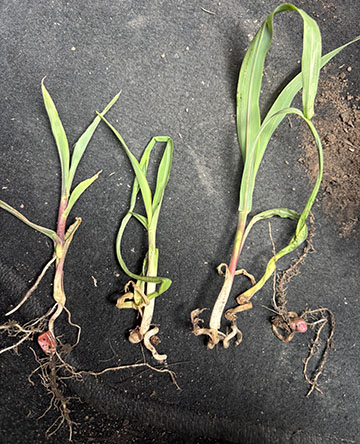
- Uneven height or leaf stage across the row, which often points to variable moisture, temperature, or seed placement.
- Corkscrewed mesocotyls or underground leafing out after cold stress.
- Plants trapped below a crusted surface, especially after hard rain on worked ground.
- Open seed furrows, sidewall compaction, or clod-related skips that trace back to planting into wet soils.
- A useful rule in corn is that uniform, slower emergence is usually less damaging than patchy emergence. If the whole field is slow because temperatures stayed cool, patience is often warranted; if neighboring plants are emerging far apart in stage, competition begins early and yield risk rises.
Soybeans deserve a different lens. Iowa State notes soybean cold injury can reduce vigor or kill seed before emergence, but soybean stands often tolerate some unevenness better than corn unless plant loss creates large holes.
Scout soybean fields for:
- Missing plants tied to seed death before emergence in cold, wet soils.
- Pale seedlings, slow hypocotyl pull, or emergence blocked by crusting.
- Swollen, weak, or rotted seedlings that suggest disease pressure in saturated conditions.
- Large gaps, especially those greater than about 2 feet, as this could lead to higher pressure later in the year.
Soybean emergence evaluation should emphasize surviving stand and gap pattern more than perfect visual uniformity. Iowa State notes soybean emergence uniformity very rarely causes enough yield loss by itself to justify replanting. Instead, the key is to confirm that enough healthy plants are present and the stand can canopy and compete.
Scouting priority for both crops:
Dig plants rather than guessing from the road. The first pass should check seed depth, moisture pattern, mesocotyl or hypocotyl condition, crusting, and whether the problem is random or tied to a soil type, tillage pass, residue band, or low spot.
Sources
- University of Minnesota Extension. “Strategies for Successful Corn Planting.” Accessed 2026.
https://extension.umn.edu/corn-planting/strategies-successful-corn-planting - Iowa State University Extension and Outreach – Integrated Crop Management. “Stand Establishment Critical for Early Planted Corn and Soybean.” Accessed 2026. https://crops.extension.iastate.edu/post/stand-establishment-critical-early-planted-corn-and-soybean
- Purdue University Extension. “Effects of Uneven Seedling Emergence in Corn (NCH-36).” Accessed 2026.
https://www.extension.purdue.edu/extmedia/nch/nch-36.html
The Earfull April 20, 2026
Early Season Insects—What to Look For
Planting season moves fast. By the time a stand problem is obvious, the window to act — or to explain it — has already closed. Early-season insects are one of the most common causes of uneven emergence, skips, and replant decisions, and they’re easy to miss if you’re not scouting at the right time.
Risk isn’t tied to one type of spring. Cool, wet soils slow germination and leave seeds in the ground longer, giving soil-dwelling pests more time to feed. But warm soils with heavy crop residue, manure applications, or recently terminated cover crops create their own risk by drawing egg-laying insects and supporting larval populations. Both scenarios show up regularly across the Renk sales area. Walking fields at or shortly after emergence — not just at canopy closure — is when these problems are catchable and explainable. Let’s review the key pest offenders:
Seedcorn Maggot (Corn and Soybeans)
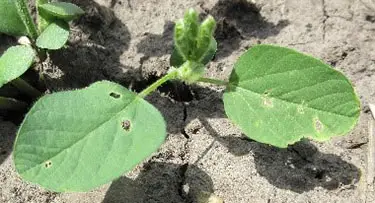
Seedcorn maggot is the larva of a small fly — pale yellow-white, legless, about ¼ inch long. Larvae feed directly on germinating seeds and young shoots before the plant ever breaks ground. Fresh organic matter is the main attractant. Fields with heavy residue, recent manure, incorporated cover crops, or freshly tilled green material carry the highest risk. Cool, wet soils compound the problem by slowing germination and extending the window larvae have to feed.
In the field, look for seeds that are hollowed out or show no viable shoot or root development. You’ll often find seedlings that started to emerge and then died at or just below the soil surface. Gaps and skips that don’t match planter performance data are a telltale sign, particularly in low-lying areas, field edges near manure application zones, or anywhere a cover crop was terminated late.
Wireworm (Corn and Soybeans)
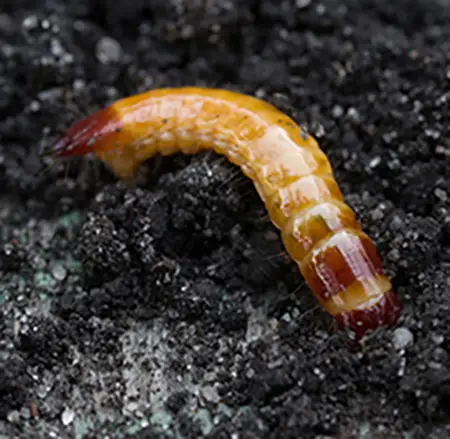
Wireworms are the larvae of click beetles — hard, shiny, orange-brown, and cylindrical, almost wire-like to the touch. They spend multiple years in the soil and feed on seeds and below-ground plant tissue. Sod ground is the classic red flag: former pasture, fields following small grains or perennial grasses, or any ground that’s been in long-term grass cover. First-year corn or soybeans after sod is the highest-risk scenario you’ll encounter.
Stand loss from wireworm tends to be patchy and irregular — not clean row skips, but odd sections or scattered holes in the field. Seeds will show entry holes or be hollowed out with the shoot or radicle chewed off. To confirm, dig 6 to 12 inches deep in problem areas; early in the season when soils are still cool, wireworms concentrate in the top few inches. Stunted, wilted, or dead seedlings where the underground stem is damaged, but the plant never fully emerged are a reliable indicator.
Black Cutworm (Primarily Corn; Occasionally Soybeans)
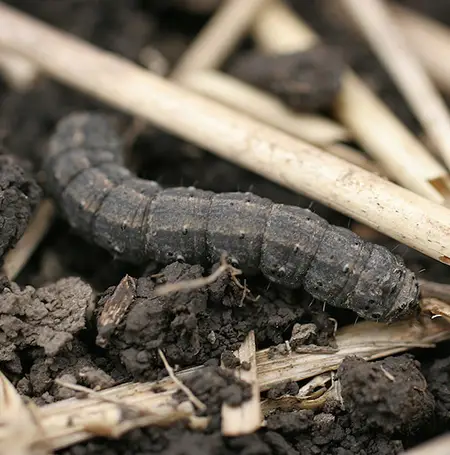
Black cutworm moths don’t overwinter in most of the Renk sales area — they migrate north on spring storm systems. Fields with winter annual weeds, heavy surface residue, or recently terminated cover crops are higher risk because they attract egg-laying moths. Corn from VE through V5 is the primary target. Soybeans can occasionally be clipped in a heavy year, but this is mainly a corn problem.
Watch for wilted or cut-off plants at or just below the soil surface, often in the first few rows from field edges or in weedy areas. Damage shows up in clusters or patches, not uniformly across the field. Before full cutting begins, you may see small, round feeding holes in leaves — that’s your early warning. When you find damage, dig in moist soil near the affected plants and look for the caterpillar itself: dark gray to black, curls into a C-shape when disturbed.
In soybeans, if pressure is unusually high, check for clipped stems or leaf feeding on early-emerged plants along field edges or in areas with residue. It’s uncommon, but worth a look in high-pressure years.
Quick Risk Overview:
No single field type has zero risk. The combination of field history — sod, cover crops, manure — residue levels, weed pressure, and spring weather determines where problems concentrate. Cool springs push seedcorn maggot and wireworm risk up. Warm springs with weedy fields and migrating storm fronts elevate black cutworm. Many fields carry more than one risk factor.
Take Home:
- Walk fields at emergence. Target fields with manure, high residue, cover crop history, sod ground, or known weed pressure first — these are your highest-risk acres.
- Dig before you diagnose. Skips and uneven emergence have many causes. Pull seeds and seedlings from problem areas and look for physical damage before attributing stand loss to cold stress or planter issues.
- Document what you find. Note field history, soil conditions, pest species observed, and estimated stand loss.
Early planting into cold soils increases seedcorn maggot and wireworm exposure. Late cover crop termination increases all three pest risks.
Sources:
- University of Wisconsin–Madison Extension — ipcm.wisc.edu
- Iowa State University Extension — crops.extension.iastate.edu
- Michigan State University Extension — canr.msu.edu/ipm
The Earfull April 13, 2026
Corn Seedling Diseases: When Mother Nature Overwhelms Even the Best Treatments
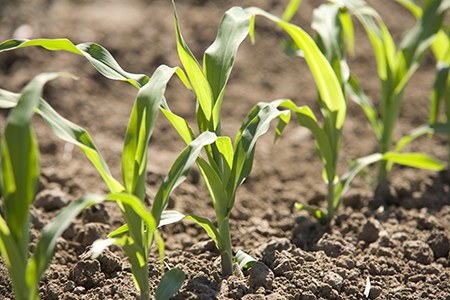
Renk Seed corn comes standard with industry-leading multi-mode seed treatment packages Metalaxyl, Fluoxastrobin, and Prothioconazole working together to protect your seedling from the moment it hits the soil. But some springs, Mother Nature tips the scales. Extended cold and wet soils after planting, or a warm saturated stretch right after emergence, can push disease pressure beyond what the seed treatment alone can fully hold back. That’s exactly why we introduced Resilient™ AP,
a planter box biological treatment designed to layer additional protection right at seeding, reinforcing root health and early vigor when conditions get tough.
The Three Main Corn Seedling Diseases
Pythium — The most common early-season threat. Thrives in cool, saturated soils (below 55°F) with standing or pooled moisture. Produces swimming spores that move through wet soil directly to the root. Infected seedlings have dark, slimy roots where the outer cortex peels away, leaving a white inner core. Seed that never emerged will be soft and rotted. Concentrated in low spots and poorly drained areas.
Fusarium — The opportunist. Covers a wider range of temperature and moisture conditions and follows plant stress, compaction, herbicide injury, temperature swings, or saturated soils. Shows up as tan to reddish-brown lesions on the mesocotyl and roots, sometimes with pink or salmon sporulation. Stressed plants invite it in; a clean planting environment keeps it at bay.
Rhizoctonia — The dry-side problem. Unlike the others, Rhizoctonia favors warmer, drier conditions and hits hardest in sandy or well-drained loam soils. Infected seedlings have firm, dry, reddish-brown lesions on the mesocotyl near the soil line, not mushy, not water-soaked. Often no obvious above-ground symptoms until the plant is stunted or chlorotic.
Resilient™ AP: Our planter box biological treatment adds beneficial microorganisms directly at seeding, colonizing the rhizosphere to compete with soilborne pathogens and support root development, extending your protection window beyond what the fungicide chemistry alone covers. In its launch year we will not have any additional supply for in-season needs.
How to Scout Corn Seedlings
Scout at emergence through V2, that’s your window before the plant either recovers or the evidence disappears. Walk problem areas and pull 10–15 plants where healthy plants transition into gaps or stunted ones.
- Examine the mesocotyl (stem between seed and soil surface) and root system after a light rinse.
- Healthy tissue is white and firm, any tan, brown, reddish, or black coloration is a red flag.
- Try peeling the outer cortex of the root. If it slides off leaving a white center, that’s Pythium.
- Firm, dry, reddish lesion at the soil line = Rhizoctonia. Mushy dark tissue = Pythium or Fusarium.
- Pythium concentrates in wet low spots. Rhizoctonia is more common on lighter, sandier soils.
Soybean Seedling Diseases: Why We Built the Defender Treatment Program
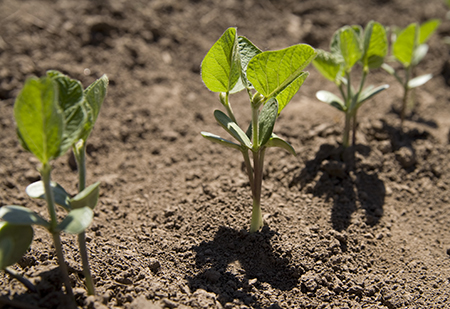
Soybeans can compensate for a lot, but they can’t compensate for plants that never made it. Soybean seedling diseases are one of the most common causes of stand loss in the Midwest, and the pathogen complex is more diverse than corn. That diversity is exactly why Renk offers the Defender treatment program. A single active ingredient isn’t enough when your field can throw Pythium, Phytophthora, Rhizoctonia, or Fusarium at you depending on soil temperature, drainage, and field history. Defender brings together the right chemistries to address these diseases.
The Four Soybean Seedling Diseases to Know
Pythium — Most common in the northern Corn Belt. Favors cool, saturated soils (50–77°F) and attacks quickly, before germination or right after emergence. Infected seeds are soft and rotted. Emerged seedlings have water-soaked lesions on the hypocotyl and cotyledons, pull from the soil with almost no resistance, and show poorly developed roots. Follows the wet spots in a field.
Phytophthora — Field-history-specific and warm-weather driven (>60°F soils + wet). Once it’s in a field, it comes back to the same low spots and high-clay areas when conditions repeat. The tell is a chocolate-brown discoloration that runs from the root up the stem, sometimes 6+ inches above the soil line, while the interior stays firm. After V2, this stem signature separates it cleanly from Pythium.
Rhizoctonia — Warm, drier conditions and sandy or south-facing soils. The lesions are firm, dry, and reddish-brown on the hypocotyl near the soil line, never mushy. Worth noting: a Rhizoctonia seedling infection that goes unnoticed in May can resurface as plant snap-off during summer wind events when the cortical rot weakens the stem base.
Fusarium — Follows stress, compaction, flooding, temperature swings, herbicide pressure. Causes brown to black root discoloration, but plants often stay standing with reduced vigor rather than dying outright. That makes it easy to miss and easy to blame on something else.
Quick Diagnostic Guide: Mushy, water-soaked tissue = Pythium or Phytophthora. Brown running up the stem above soil = Phytophthora specifically. Firm, dry reddish lesion on hypocotyl = Rhizoctonia. Brown-black root staining, plant still standing = Fusarium.
How to Scout Soybean Seedlings
Your scouting window is emergence through V2. After that, surviving plants are largely past the worst of the seedling disease risk, but the evidence of what happened is fading fast.
- Pull 10–15 plants from the edge of a problem area and examine the hypocotyl and roots.
- Check the soil line first, the classic Phytophthora brown line moves up the stem from the root.
- Mushy roots with no structure = oomycete. Firm reddish lesion on hypocotyl = Rhizoctonia. Brown-black lower root staining = Fusarium.
- After V2: Phytophthora shows stem discoloration above the soil line; Pythium damage stays at the hypocotyl and below.
- Count your stand, a final stand below 80,000 plants/acre (narrow rows) or 100,000 plants/acre (wide rows) costs yield. Run the math before replanting into June.
- Use a hand lens: Fusarium often shows pink-salmon tissue coloration. Phytophthora does not, it stays brown to tan.
Sources
- Crop Protection Network. “An Overview of Soybean Seedling Diseases.” cropprotectionnetwork.org (2026).
- University of Nebraska–Lincoln CropWatch. “Conditions Favor Seedling Diseases in Early Planted Corn and Soybeans.” cropwatch.unl.edu (2022).
- University of Wisconsin Extension. “Seed Treatment Fungicides — Corn and Soybean.” fyi.extension.wisc.edu (2010).
The Earfull April 6, 2026
Corn Planting Depth Is the Detail
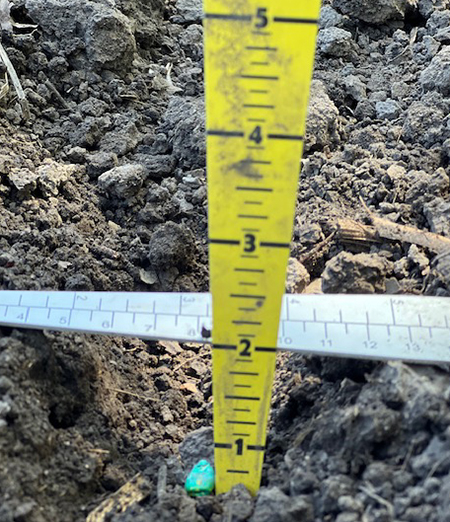
Two inches. That is the number worth remembering before a single row unit hits the ground this spring. Not 1.5, not 2.5 as a default—two inches of seed-to-soil contact in firm, moist ground sets up everything that follows. At that depth, the seed sits where soil moisture is consistent enough for uniform germination and temperature swings are buffered enough to keep imbibition steady. Move half an inch shallower and you are in the zone that dries out first after a warm afternoon. Move deeper without reason and you slow emergence, giving seedling diseases more time. The goal: get every kernel into a consistent moisture band so germination happens at roughly the same time across the field. Uniform emergence is one of the highest-value things you control at planting, and depth is the biggest lever.
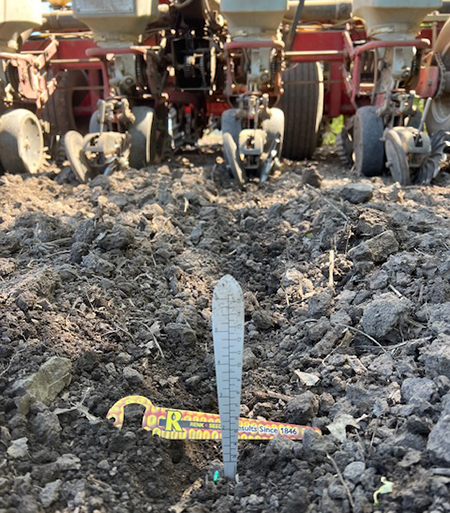
If you are going to err, err deep. Shallow planting—anything under about 1.5 inches—is where real trouble starts. Corn develops its permanent nodal roots from the crown, which forms roughly three-quarters of an inch below the soil surface regardless of seeding depth. The mesocotyl elongates upward until the coleoptile senses light, then stops. When the seed is only an inch down, the crown ends up close to the surface and nodal roots try to anchor in soil that bakes out on a sunny day. That is the setup for rootless corn syndrome—“floppy corn”—where hot, dry weather between V1 and V5 kills young roots before they establish. Seeds near the surface also sit closer to pre-emerge herbicide concentrations in the top half-inch, raising the odds of early-season injury, and they are in the part of the profile that dries fastest, making germination spotty if rain does not follow the planter. University trials consistently show that planting at one inch versus two results in less uniform stands and lower yields—in some cases the gap has been 14 percent or more.
Two inches is the target, but not a universal constant. A heavy silt loam still holding spring moisture might plant well at 1.75 inches, while a well-drained sandy loam across the road might need 2.5 inches to find consistent moisture. Early-planted fields tend to have moisture near the surface; by mid-May on lighter soil that moisture line drops and you need to follow it. Soil type, tillage, residue cover, and slope aspect all shift where the moisture band sits.
Here is what catches people: the monitor says 2 inches, the depth wheels are set, and the first check looked good. But by mid-afternoon the field has changed, or you have moved farms, or the outer-wing row units are bouncing over residue and running a quarter-inch shallow. Knolls run shallower than valleys. Headlands compact differently. The fix: stop the planter, walk back, dig five or six seeds, and measure with a ruler, a pocket knife, or the width of your thumb. Check every field, again when conditions change, once more on the knolls. Five minutes—the cheapest agronomic check available.
The consequences do not always show at emergence—they show later. If the crown formed close to the surface in May, the nodal roots are shallower than they should be all season. By late July, when the plant is filling grain and burning stalk carbohydrates, a weaker root system means less water uptake, less anchorage, and more lodging risk when a storm rolls through. You can trace a September lodging problem back to a depth decision made four months earlier. Pull a few seeds, confirm you are in moisture, and make sure every row unit is putting kernels where they belong.
Beans Are Pickier Than You Think—Here Is Why Depth Still Matters
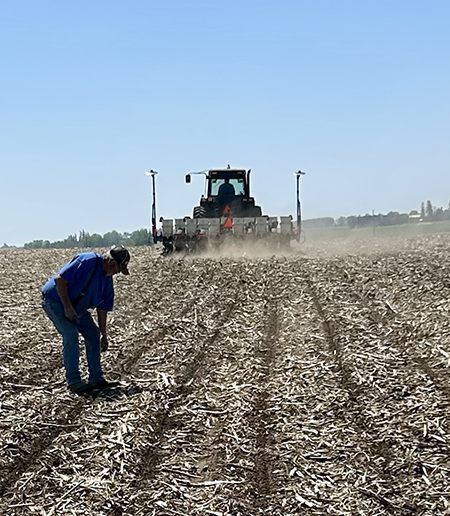
Soybeans have a tighter depth window than most people give them credit for. Under most upper Midwest spring conditions, the target is 1 to 1.5 inches, and the overriding rule is to plant into moisture. A soybean seed needs roughly half its weight in water before germination starts. If the seed is at the right depth on paper but sitting in dry soil, nothing happens until it rains—and by then you have lost days and stand evenness.
Why Beans Cannot Handle Deep the Way Corn Can
Corn pushes a coleoptile upward on a mesocotyl that can elongate from three inches or more. Soybeans do not work that way. They pull their cotyledons up through the soil on a hypocotyl arch with a smaller energy reserve and less mechanical power. Past about two inches in a heavy or crusted soil, there is a real chance the seedling runs out of stored carbohydrates before reaching daylight. The cotyledons are large relative to the stem and dragging them through dense or sealed ground takes energy a shallowly planted seed would never spend. Corn has a margin for error; soybeans do not, especially in fine-textured soils that crust after rain.
Most Fields Are Off Target—and Usually Too Deep
Depth surveys across Midwest fields consistently show that a surprising number of soybean acres are planted outside the recommended window. The most common miss is too deep, not too shallow—particularly on drill-planted acres. When our DSMs walk the soybean fields, they routinely find beans at 1.75 to 2.5 inches, especially in tilled ground where fluffy seedbeds makes it hard to gauge true depth from the cab.
Planters generally hold depth better than drills or air seeders—individual parallel-link arms with down-pressure follow contour more closely. Drills flex across their width with less unit-by-unit control, so seeds at the center can be at one depth while seeds on the wings are at another. Even on a planter, outer-wing row units often run lighter and shallower than center units in uneven terrain or heavy residue. That wing-to-center variation can be half an inch—enough to put center-row beans in moisture and wing-row beans in dry soil. Dig behind the wings, not just the center.
Cooler, wetter, heavier soils early in the season call for the shallow end—closer to 1 inch—because the seed does not need to go deep for moisture and faster emergence reduces disease exposure. Later planting, sandier ground or drier conditions push depth to 1.5 inches; in a genuinely dry spring you might go to 2 inches to chase moisture, understanding the extra risk. Seed size matters too—larger seed carries more energy for deeper emergence but bigger cotyledons are harder to pull through a crusted surface. Factor the variety’s emergence score and the soil type into the decision, not just the calendar.
Dig seed every few fields, check actual depth against the monitor, and confirm the seed is in at least half an inch of moisture. Check behind the wings, not just the center. Adjust before you plant another 40 acres at the wrong setting. Soybean stands are hard to fix after the fact—you cannot profitably re-plant a thin spot and you cannot add roots to a plant that exhausted itself emerging from too deep. Take the five minutes. It pays.
Sources
1. Purdue University Extension, Pest & Crop Newsletter—“How Deep Should Corn Be Planted?” and “Rootless or Floppy Corn Syndrome.” https://extension.entm.purdue.edu/newsletters/pestandcrop/
2. Michigan State University Extension—“Soybean Planting Depth Matters.”
https://www.canr.msu.edu/news/soybean_planting_depth_matters
3. Iowa State University Extension, Integrated Crop Management—“Soybean Seed Depth in Dry Conditions.”
https://crops.extension.iastate.edu/post/soybean-seed-depth-dry-conditions
No post found

No post found
No post found
No post found
No post found
No post found
No post found
No post found
No post found