Disease Triangle Building in Corn
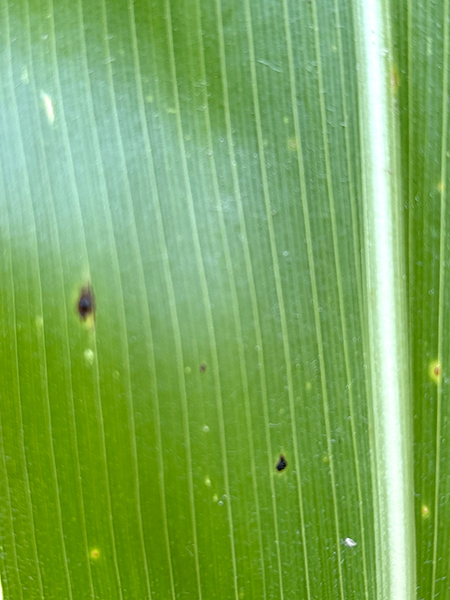
Corn disease risk is starting to organize around the classic disease triangle: a susceptible host, active inoculum, and favorable weather. In 2026, that conversation centers on tar spot first, with northern corn leaf blight, gray leaf spot, and other residue-driven foliar diseases also worth watching as more acres move toward rapid canopy closure and the pre-tassel period.
Tar spot has already been confirmed at low levels in parts of the region this season, which means inoculum is present. Fields with a previous history should move higher on the scouting list.
The weather setup over the next two weeks adds another layer of concern. The latest Climate Prediction Center outlook favors above-normal temperatures across much of the Corn Belt, while above-normal precipitation is favored across much of the Upper Midwest and Great Lakes region. This combination does not automatically mean a disease outbreak. It does increase the odds that leaf wetness, canopy humidity, and repeated moisture events begin to support disease development in the fields that already have the rest of the triangle in place.
Disease Triangle: Why This Matters Now
The disease triangle remains the simplest and best framework for making disease decisions in corn.
Disease pressure only builds when three pieces overlap:
- A host that can be infected.
- Inoculum present in or near the field.
- Weather favorable enough to support infection and spread.
In most Renk geographies, the host is already there, and the inoculum is no longer theoretical. For tar spot and northern corn leaf blight in particular, residue and local history matter. The swing factor in late June is weather, especially repeated rain, long dew periods, humidity, and canopy moisture that keeps leaves wet into the morning hours.
Tar spot is the disease drawing the most attention because it can move quickly once conditions turn favorable. Extension guidance for 2026 continues to emphasize that current early-season detections are low-incidence and low-severity. This is not a signal to make blanket fungicide applications on vegetative corn. That distinction matters. The right takeaway is not “spray now.” The right takeaway is “know which fields deserve tighter scouting intervals.”
What Could Be on Deck
Tar spot
Tar spot should remain the lead watch-out over the next two weeks. Heavy emphasis is on fields with a history of the disease, continuous corn, heavier residue, irrigation, or longer periods of canopy wetness. University guidance this season notes that findings have been at low incidence and severity in early vegetative corn, and that fungicide applications at these stages have generally not been economical. That means the practical response is targeted scouting and field ranking, not automatic treatment.
Northern corn leaf blight
Northern corn leaf blight warrants attention in fields with high residue and less-forgiving hybrids. It tends to move more effectively when leaf surfaces stay wet and humidity remains elevated. This is especially true as the crop approaches tassel and the canopy begins to hold moisture longer. If the coming pattern delivers repeated moisture without fast drying, this disease can move from background concern to active management discussion.
Gray leaf spot and other foliar disease pressure
Gray leaf spot remains on the “watch list” when warm, humid weather combines with residue and dense canopy conditions. It is rarely about one factor alone. It is usually the combination of field history, environment, and crop stage that determines whether disease remains cosmetic or begins threatening upper-canopy leaf area. The same logic applies to other common foliar diseases that can build when extended humidity and residue are part of the system.
What to Do Right Now
For the next two weeks, the highest-return management step is field prioritization.
Start with the fields most likely to move first:
- Corn-on-corn acres
- Fields with known tar spot or foliar disease history
- High-residue situations
- Irrigated fields or fields with prolonged overnight wetness
- Denser canopies that are beginning to hold humidity
- Acres approaching tassel sooner than the rest of the operation
Then, tighten scouting intervals in those fields. A practical approach is to avoid treating every field the same. A rotated field with lower residue and faster drying conditions does not need the same urgency as a pivot field with prior tar spot history and frequent leaf wetness.
Scouting should stay focused on lower-canopy and mid-canopy symptom development, but the real decision point is what is happening as fields approach VT and R1. If disease remains low in the canopy and pressure is limited, the best economic move may still be to wait. If favorable weather continues and disease begins threatening the upper canopy or ear-leaf zone, that is when fungicide conversations become more actionable.
Timing for Best ROI
Current multi-state extension guidance continues to support the idea that fungicide timing matters more than simply being early. For tar spot and other foliar diseases, the best return typically comes when applications are made in the VT to R3 window, not during early vegetative growth. Early applications may look proactive, but they often do not persist long enough to protect the crop during the most important grain-fill period and have generally not proven economically viable under university guidance for 2026 conditions.
A simple ROI framework:
- Too early: Disease is present at very low levels in vegetative corn, mostly low in the canopy, with limited immediate threat to the ear leaf or upper canopy.
- Best window: VT/R1 through R3 when disease is active, weather remains favorable, and the goal is to protect the upper canopy during the highest-value period.
- Lower return: Applications made after meaningful upper-canopy disease is already established often lose value quickly.
The best recommendation for growers is to match timing to risk, not anxiety. Protect acres most likely to respond, protect them in the window most likely to return, and avoid broad “insurance” passes that are not tied to field-level disease pressure or crop stage.
EARFULL Talking Point
The disease triangle is starting to form in 2026. Tar spot is already in the conversation, and the next two weeks look supportive enough to raise scouting priority across higher-risk corn acres. The best ROI move today is not automatic early fungicide. It is a strategic field ranking, closer scouting, and preparation to act in the VT/R1 to R3 window, where foliar disease protection has the best chance to pay.
References
- University of Nebraska-Lincoln CropWatch. “Making Fungicide Decisions for Corn and Soybean in 2026.”
https://cropwatch.unl.edu/making-fungicide-decisions-corn-and-soybean-2026/ - NOAA Climate Prediction Center. “6-10 and 8-14 Day Prognostic Discussions.” https://www.cpc.ncep.noaa.gov/products/predictions/610day/fxus06.html
- Cooperative Farmers Elevator. “2026 Crop Disease Outlook.”
https://www.coopfe.com/2026-crop-disease-outlook/