What the Ears Are Saying
Corn pollination has moved from “about to happen” to “already in the rearview” on a lot of acres. From the road, many fields still look strong. The real story now is on the ears themselves. The key three questions:
- Did this field actually pollinate well?
- Where are the weak spots hiding?
- How do we turn today’s ears into a useful yield and management conversation for fall?
The right time to look is…
- Tassels are mostly done or nearly done shedding.
- Silks have turned brown and are starting to dry down.
- You’re roughly 5–10 days past peak tassel in that field.
The fields that might be the best to pull into the driveway and see what the ears are saying: 1) Fields that hit tassel during a hot, dry stretch; 2) Lighter soils, compacted ends, and uneven zones that rolled early;
3) Later‑planted fields that just wrapped pollination under a different weather pattern. Then you will know which fields look good with ears that back that up—or don’t.
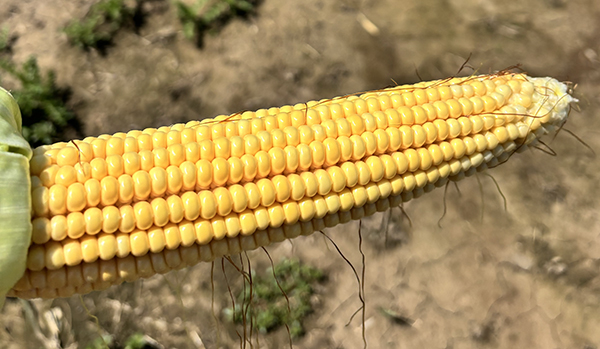 The ear silk shake test simple, quick, visual
You don’t need a complicated procedure to grade pollination. The straightforward shake test that works well in the field. It takes about 30 seconds per ear and gives you a clear picture.
- Walk 50–100 feet in and pull 3–5 plants in a row.
- Choose ears where silks are mostly brown and dry.
- With a sharp knife, slice the husks from butt to tip and peel them back, leaving silks attached.
- Hold the ear horizontally and gently shake it.
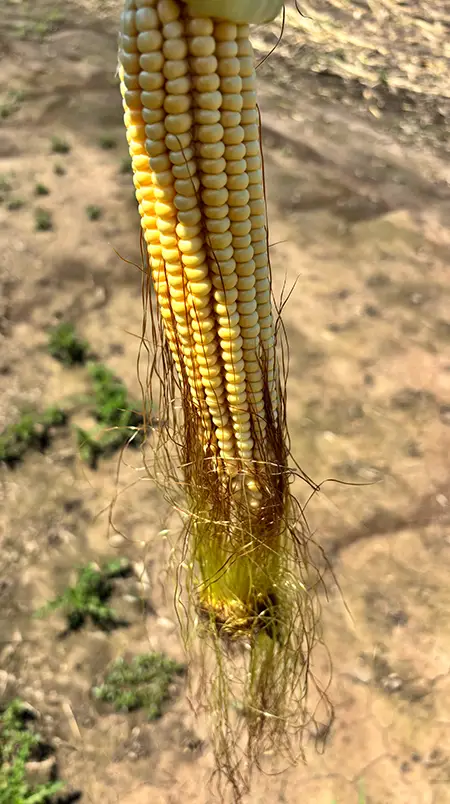 Watch what the silks show you. Silks that fall away are tied to fertilized kernels. Silks that stay stuck mark ovules that never got pollen. You don’t need a chart. Your eyes do the work.
As kernels move deeper into grain fill, it’s worth taking a second look at ears you checked earlier in pollination and see how they’re actually filling out. A little “tip‑back”—a short, blank section at the very end of the cob—is common and can come from either late silks that never caught pollen or from the plant quietly aborting the youngest kernels when it doesn’t have the energy to finish them. What deserves more attention is how that poor fill shows up. If the blank area is limited to the last half‑inch or so at the tip, the field may still be in good shape. When blank space or shriveled, aborted kernels start marching further down the ear, or when you see entire rows missing along one side of the cob—the classic “zipper” pattern—this points to more serious stress during early grain fill. In those cases, the plant set kernels but later ran short on photosynthate due to drought, heat, nutrient limitations, or heavy disease pressure, and it shed part of the load to protect the remaining kernels.
Turning ears into a yield range
What is the yield of this field? Here is a basic method to calculate the range:
- In 30‑inch rows, measure a row length of 17’ 5” (1/1000 acre).
- Count the harvestable ears in that stretch and multiply by 1,000 for ears per acre.
- Count kernels per ear (# of kernel rows × # kernels length) – only count actual kernels—skip blank cob and severely aborted tips.
- Yield (bu/ac) ≈ (ears/acre × kernels/ear) ÷ 85,000–95,000. Use around 85,000 if the crop is healthy and kernels look like they’ll fill well; use closer to 95,000 if stress has obviously thinned or shortened them.
Soybeans: pod set check, not pod count marathon
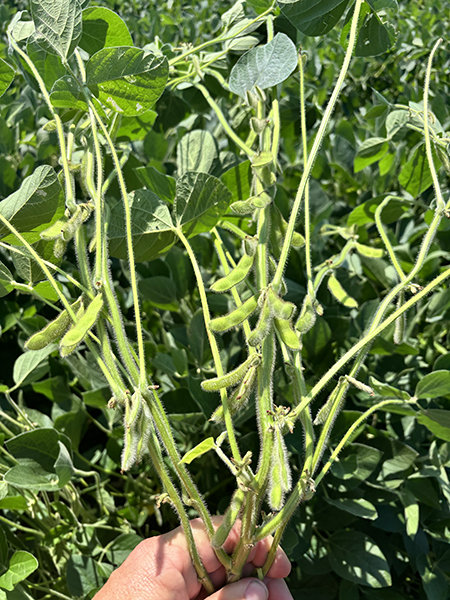
While we’re focused on ears, soybeans are quietly making their own big decisions. Many fields are in full pod to early seed (R3–R5). This is when beans decide how many pods to keep and work on how full those pods will be.
You don’t have to count every pod to learn something useful. Three quick questions in beans:
- How is pod load spread up the plant? Walk the row and pull a few plants. Look for pods building from mid‑canopy into the upper third of the plant. A good plant usually has pods stacked on most nodes, not just at the bottom.
- Where are pods being shed? Some flower and tiny pod drop is normal; beans use it as a safety valve.
The worry point is heavy pod loss up top or on branches that line up with late-season stress—
heat, drought, or disease. - What could trim seed size from here? Dense canopies, warm nights, and sticky mornings are great for disease. Fields with a history of white mold or SDS deserve closer attention as we move deeper into pod and seed fill.
Recent soybean growth‑monitoring work reinforces a simple truth. What happens in August can push you from “average” to “better than expected,” or quietly shave a few bushels off the top.
References
- University of Wisconsin–Madison Extension. “Concerns about Drought as Corn Pollination Begins.” Wisconsin Corn Agronomy.
- Purdue University Agronomy. “Estimating Corn Grain Yield Prior to Harvest.”
- Iowa State University Extension and Outreach. “Corn Yield Estimates.” Integrated Crop Management.