As Harvest Nears
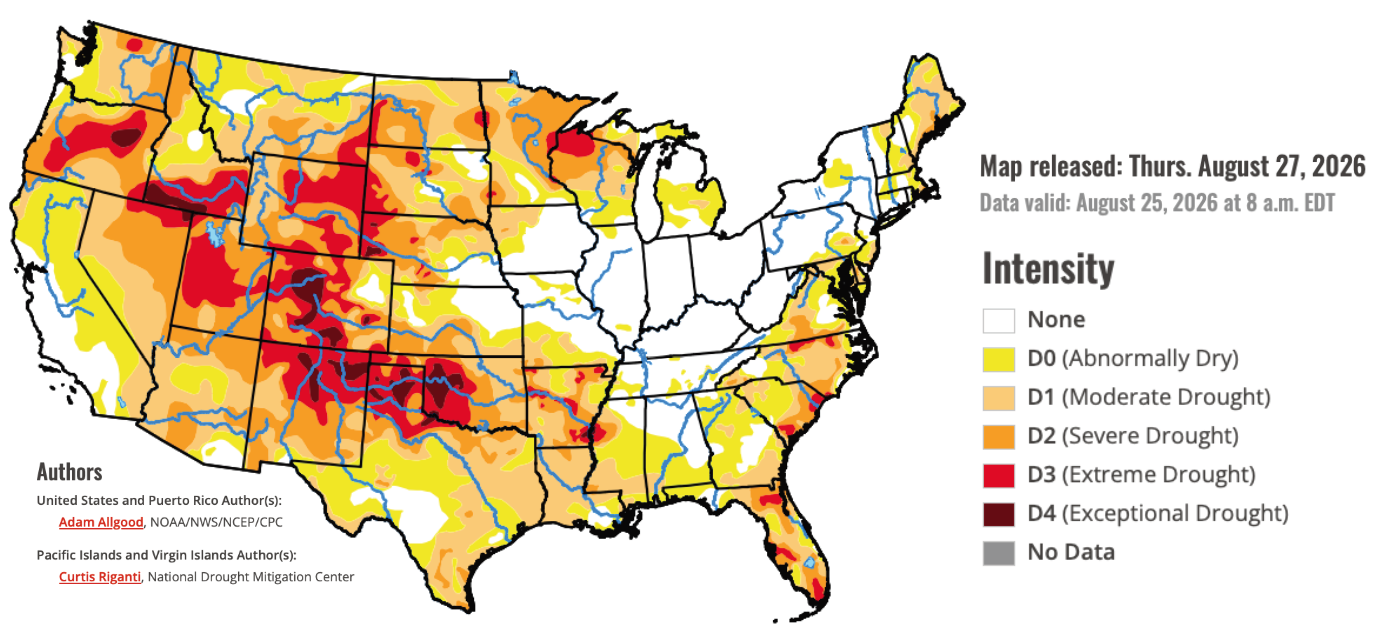
As we move into September, drought is becoming one of the biggest variables separating fields across the Renk Seed area. The map does not tell the entire story—and neither does a drive down the road. Some acres caught timely rain and still have strong finish potential. Others have been running short of water for weeks, and they are showing it in earlier drydown, lighter grain fill, shorter plants, weak pod fill, or uneven maturity.
The latest U.S. Drought Monitor puts the sharpest late-season concern across parts of Minnesota, western and northern Wisconsin, and Michigan’s Upper Peninsula. Severe drought (D3) expanded across northwestern Wisconsin and into eastern Minnesota during the August 25 assessment. The same update noted some relief from showers in Michigan and southern Wisconsin, while another dry week aggravated ongoing impacts farther north and west.
That pattern lines up with what makes drought difficult to manage across the Renk Seed area: there is no single “Renk crop condition.” From Michigan into Wisconsin, Minnesota, the Dakotas, western Iowa, and
non-irrigated Nebraska, rainfall has been highly variable. Two fields only a few miles apart can be headed into harvest with very different yield, moisture, feed-value, and plant-health stories.
https://droughtmonitor.unl.edu/CurrentMap/StateDroughtMonitor.aspx
Corn: Grain Fill Is Still the Question
Corn is far enough along that the yield ceiling has largely been set, but late-season stress can still affect what makes it into the bin. Corn plants that ran short of water during grain fill may finish faster, show premature firing, lose stalk integrity, and end up with lighter kernels. The crop may look like it is “drying
down nicely,” when the reality is it’s finishing early because it ran out of water.
That is why field-by-field scouting matters right now. Pull ears from the good, average, and stressed areas
of each field. Look beyond kernel number and evaluate kernel depth, tip fill, ear consistency, plant health,
and stalk condition. Compare those observations to soil type, planting date, hybrid placement, rainfall timing, and any compaction or drainage pattern. The result is a much more useful harvest conversation than a whole-field estimate made from the road.
Late-season drought also raises the importance of stalk quality. A stressed plant may remobilize carbohydrates from the stalk to finish the ear. Add leaf disease, nutrient stress, root restriction, or insect feeding, and the risk of stalk cannibalization and lodging can increase. Prioritize fields with weak lower stalks, heavy ear load, visible firing, or early plant death for harvest rather than leaving them until last.
For irrigated acres, the decision is not simply whether the season has been dry. It is whether enough usable water remains in the root zone to finish the crop. Corn at beginning dent can still use about 2 inches of water through maturity, while corn at half milk line has about 0.8 inch remaining. The best final-irrigation decision combines growth stage, actual root-zone moisture, and the near-term forecast—not the calendar alone.
Corn Silage: Moisture Moves Fast in Stress Fields
Drought-stressed silage corn can move from “not ready” to “too dry” quickly. Whole-plant moisture must drive harvest timing; calendar date, kernel milk line, and field appearance are useful clues, but they are not a substitute for sampling. In a variable field, pull representative plants from multiple zones. Sandy ridges, shallow soils, compacted headlands, and the best portions of the field may not be at the same moisture.
Dry silage is harder to pack and is more vulnerable to heating and spoilage. Lower biomass also changes the feed-inventory conversation, especially on dairy and livestock operations that were counting on a normal-tonnage crop. If plants are drought-stressed, evaluate both quantity and quality before finalizing chop plans. Shorter cut length, careful kernel processing, aggressive packing, prompt covering, and a realistic inventory estimate become even more important when the crop is dry and variable.
Soybeans: Pod Fill and Plant Health Still Matter
Soybeans generally have more flexibility to recover from stress than corn—until moisture is short during pod and seed fill. The University of Minnesota notes that soybeans at beginning seed (R5) may use about 2.9 inches of water through maturity, compared with about 1.2 inches at full seed (R6). A timely rain can still add seed size and help retain yield; continued stress can mean small seed, aborted pods, uneven maturity, and a field that is ready sooner than expected.
Walk soybean fields with two questions in mind: Is this drought, or is drought exposing another problem? Dry conditions can make potassium deficiency, compaction, shallow rooting, soybean cyst nematode, sudden death syndrome, white mold history, herbicide injury, and poor drainage patterns easier to see. Symptoms that line up in zones or patches deserve a closer look before the combine erases the evidence.
This is also a good time to watch for green stem, uneven maturity, lodging, and late-season disease. In North Dakota, soybean condition is declining in much of the region under drought, along with reports of late-season potassium deficiency. Drought can reduce potassium movement to roots and make deficiency symptoms more apparent even in fields that are not extremely low in soil-test K. There may be no practical rescue treatment now, but these fields should be flagged for fall soil sampling, yield-map review, and next season’s fertility plan.
What Does It Mean?
This is not a year to make broad conclusions from one yield monitor map or one field visit. Drought response is a combination of rainfall timing, soil water-holding capacity, rooting depth, crop stage, hybrid or variety placement, fertility, and field history. The fields that look best today are not always simply the ones that received the most rain; they are often the fields that captured and held water, established roots early, and had fewer secondary limitations.
As harvest starts, the most valuable work may be documenting the story behind performance. Note the fields that held green longer, filled grain better, retained pods, maintained stalk strength, or stayed more consistent across soil zones. Just as important, document the fields that fell apart early. Was it light soil? Compaction? A planting-date issue? Fertility? Disease? A hybrid-by-field mismatch? Rainfall timing? Those notes turn this year’s drought into better product placement, better agronomy conversations, and better decisions for 2027.
Heading Into Harvest: What We’re Watching
- Scout before scheduling. Check stalk strength, ear retention, kernel depth, plant death, pod fill,
and maturity differences. Prioritize fields with lodging risk or fast dry-down. - Sample silage often. Use whole-plant moisture from representative areas—not just one grab sample
or milk line—to time chopping. Stress fields can vary greatly and dry rapidly. - Know the feed story. Estimate silage tonnage conservatively, manage packing and storage carefully,
and test drought-stressed feed for nitrate risk before feeding. - Separate drought from other causes. Flag patterns that match soil type, compaction, drainage, fertility, disease, or traffic. Harvest maps are much more valuable when they are paired with field notes.
- Watch soybean finish closely. Fields at R5-R6 can still respond to moisture, but drought may speed maturity and reduce seed size. Be ready for uneven dry-down and harvest timing.
- Use harvest to build next year’s plan. Pull post-harvest soil samples where conditions allow, especially for residual nitrogen and in fields with drought-related variability. Compare yield maps with drought zones and scouting notes before finalizing product placement.
A drought year has a way of exposing the limits in every field—but it also provides some of the clearest information we get. The goal now is not to explain every acre before the combine rolls. It is to capture
the observations that will help make the next crop more resilient.
References
- U.S. Drought Monitor. “Midwest Drought.” Data valid August 25, 2026.
- University of Minnesota Extension. “Do I need to irrigate again? Late-season irrigation considerations.” August 24, 2026.
- North Dakota State University Extension. Crop & Pest Report. August 27, 2026.