Heat and Wind: Regional Product Impacts
Corn is moving fast across the Renk sales area, and that fast growth is exposing two different structural issues in the same season: floppy corn and early greensnap, also called brittle snap. They can show up after the same weather pattern, and they can both be blamed on wind, but they are not the same problem. Floppy corn is mainly an anchorage issue tied to nodal root development, while early greensnap is a stalk failure issue tied to rapid growth and storm timing.
That distinction matters right now because some growers are seeing fields lean or flop after wind, while others are seeing plants actually break off in an earlier-than-normal snap window. This year’s crop has advanced quickly enough that both problems can be present at once, sometimes even within the same general geography.
Floppy Corn
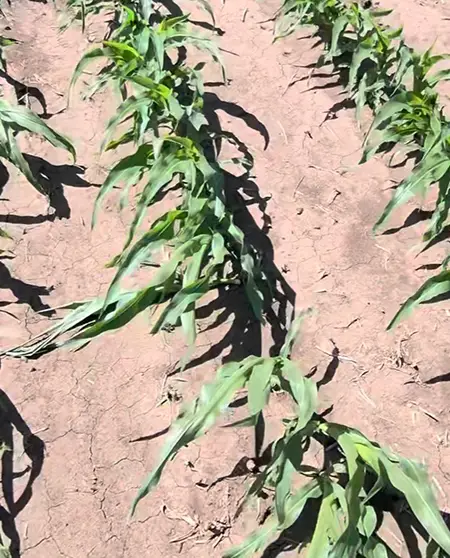
Floppy corn, often called rootless corn syndrome, develops when nodal roots fail to anchor the plant well enough as it transitions out of dependence on seminal roots. The field symptom is familiar: corn may look green, healthy, and aggressive from the road, but after a windy day it leans badly or lays over because the crown root system did not establish enough hold in the soil.
This issue usually traces back to conditions around planting and early root establishment. Shallow planting, loose or fluffy seedbeds, rapid drying near the soil surface, crusting, erosion around the row, and compaction that interferes with nodal root development can all leave the plant under-anchored at the exact time it starts adding height quickly.
This is why floppy corn can show up even in fields that otherwise seem to have excellent color and above-average early vigor. In fact, the fast growth itself can make the problem look worse because a taller, rapidly expanding plant puts more leverage on a root system that is not yet fully secured.
In some areas, this season has created a good setup for floppy corn because growth has moved quickly while surface moisture has remained variable. Wisconsin Extension noted that rainfall patterns have been uneven. Stop-and-go moisture can leave the upper root zone unfavorable for nodal root establishment, even when the crop still looks good overall. On plants where the upper inch or two dried down quickly, nodal roots may have struggled to become fully grown and anchor before wind events tested them.
It is also important to remember that floppy corn is not always uniform across a whole field. It often shows up in lighter soils, sidehills, worked ends, compacted zones, or places where the crown area is effectively positioned too close to the soil surface. That patchiness is one reason the problem can be underestimated until a storm, high winds, or even a trip across the field makes the weak-rooted plants obvious.
Product differences may also influence how often floppy symptoms show up and how well plants recover after stress. Environment and planting conditions are still the main drivers, but field experience supports the idea that not every product responds the same way when root establishment is challenged. The encouraging side of floppy corn is that some plants can recover if they receive timely rainfall and are able to push a stronger nodal root system after the stress event.
Early Greensnap
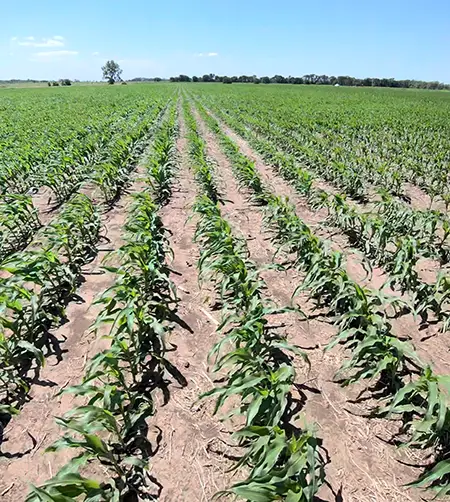
Alongside floppy corn, some growers are reporting early greensnap after major wind events. This is different from leaning or rootless corn because the stalk is actually broken, usually at or near a node, rather than simply tipping because roots failed to anchor the plant.
What makes this notable in 2026 is the concern is coming from an earlier window than typically thought about by many growers. Agronomy references describe an early greensnap risk period around V5 to V8. This lines up with reports from fields that were around V4 to V6 and entering a rapid structural change when storms came through. Most years, greensnap gets the attention later, from V8 toward tassel, because that is when corn is visibly tall and rapidly elongating.
Not every product responds the same way under the same weather event. Hybrid differences in greensnap susceptibility are real, which is why some fields, products, or placement zones may show more breakage than neighboring acres exposed to a similar storm.
Another part of the discussion is whether herbicide programs may have contributed to some of the early snap reports. The answer is yes. They can be part of the risk picture, especially where growth regulator herbicides were applied during the V5 to V8 period.
This is especially true in a year when crop growth has been so rapid. A field moving quickly through V5 to V8 can already be structurally tender, so any additional stress or hormonal affect from a growth regulator program may help explain why some acres were more brittle than expected when the storm arrived.
Takeaway
The main takeaway this week is that rapid early growth has exposed weak points in more than one way. Floppy corn remains a major part of the story because many plants are being tested before nodal root systems are fully secure, while early brittle snap is surfacing because storms are colliding with corn just as it enters a fragile growth window.
This is why the current season feels different: uneven surface moisture, fast development, high wind events, hybrid differences, and possibly growth regulator timing are all layering together. The best agronomy conversations right now are the ones that separate floppy corn from true stalk snap. Then, work backward through field conditions, product response, and management timing to understand each field’s reaction.
References
- Iowa State University Extension and Outreach, Rootless corn syndrome. Background on floppy/rootless corn, nodal root failure, recovery, and management.
https://crops.extension.iastate.edu/encyclopedia/rootless-corn-syndrome - Iowa State University Extension and Outreach, Greensnap. Early-season brittle snap, hybrid differences, and management considerations.
https://crops.extension.iastate.edu/encyclopedia/greensnap - University of Wisconsin-Madison Extension, June 4th, 2026 Weather Outlook. Wisconsin weather setup relevant to current crop growth and stress conditions.
https://cropsandsoils.extension.wisc.edu/june-4th-2026-weather-outlook/