What Needs Attention Right Now
By this point in June, the crop has usually settled enough that the overall story starts to look fairly positive from the road. A lot of corn has good color. A lot of soybeans are moving along. Most fields are far enough along that the season feels established rather than uncertain. This is the good news.
The other side of the story is that it’s also the time when averages become less useful. As a whole, the field can still look decent and yet have enough stress pockets, stand variation, root issues, or weed escapes to quietly trim yield potential before anyone fully realizes it. This is why the better agronomy conversations right now are shifting away from broad planting progress and toward a much more practical question: where is the crop beginning to separate inside the field?
Nationally, the crop remains in a generally workable position. USDA condition ratings suggest both corn and soybeans are still holding together reasonably well as we move deeper into June. That is encouraging. But those ratings do not tell the full local story, especially in areas where compaction, variable rainfall, sidewall effects, crusting, uneven emergence, or herbicide timing are now becoming more apparent.
Corn
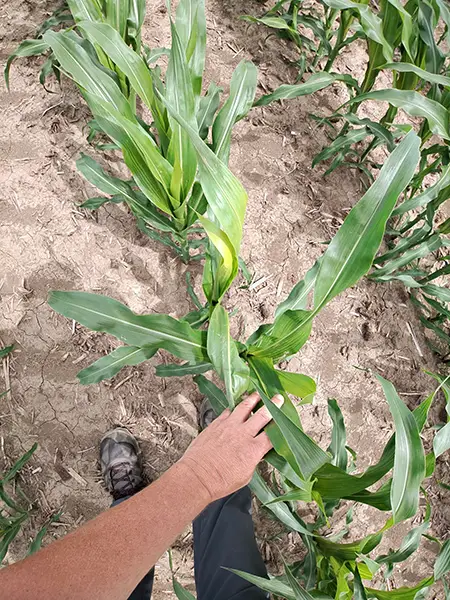
Corn is moving fast enough now that some early-season issues can get masked for a while. A field may have a strong green color from the road and still contain areas where root development is weaker than expected, growth is uneven, or nutrient uptake has been limited by early conditions. In many cases, these are the same places that tend to show up every year: sidehills, worked ends, low spots, compacted zones, or fields where planting conditions were just a little less forgiving than the grower thought at the time.
This is a good week to look beyond color alone. Pale or uneven corn does not always mean the same thing. Sometimes, it is a temporary response to cooler soils or saturated conditions that the crop will largely outgrow. Other times, it is a sign that the root system never fully established itself as it needed to. Or, it could be that nitrogen and sulfur uptake are lagging because the plant has not had ideal conditions to keep pace with rapid vegetative growth.
The main point is to identify whether the pattern is random or repeatable. If the issue lines up with wheel tracks, drainage patterns, soil changes, or known parts of the field, there is usually something useful to learn from it. Those are the fields worth digging. Pull some plants. Check root development. Look for sidewall restriction, shallow roots, crown health, and whether nodal roots are doing what they should at this stage.
Soybeans
Soybeans deserve the same kind of attention right now, even though they can be easier to overlook. A soybean field often has a way of appearing acceptable until you walk farther into it. Once you walk into it, things may begin to stand out more than they did from the road: thinner areas, uneven growth, crusted pockets, ponded spots, or delayed sections.
This is especially true in fields that were planted in less-than-ideal conditions or in those that had an uneven start. In June, soybeans can still compensate for a lot. They compensate best when the stand is more uniform than it first appears and when stress remains relatively limited from this point forward. Where populations have thinned or roots are restricted, the field may still be fine overall, but it deserves a closer look before writing it off as “good enough.”
This is also the point where weed pressure starts becoming more visible. Residual programs that looked solid earlier can begin to lose their edge, and escapes start showing up in the fields that were a little delayed, a little uneven, or simply stretched on timing. That does not mean every field has a major weed problem. It does mean this is the week to identify the acres where weeds are starting to win small battles before they become larger ones.
The Next 7 to 10 Days
For the next week or so, the best use of scouting time is probably not in the cleanest or most even fields. It is in places that feel just a little off. That could be corn that is not quite as uniform as the neighboring field. It could be soybeans that seem a little thinner than expected. It could be fields where the first pass looked good, but you are starting to wonder if weeds are slipping through.
In corn, keep the focus on stand consistency, root strength, and whether stress follows a clear pattern. In soybeans, count viable plants in weaker spots, look at root development, and ensure emerging weed escapes are identified while practical options are still available. This is also a good time to make notes that will matter later. Many of the best decisions in July and August come from observations made now.
There is still a lot of yield potential ahead for this crop. Most acres do not need a dramatic reaction. They need a careful eye, timely walking, and a willingness to investigate the areas that are easy to dismiss when the rest of the field looks fine. This is usually where the most useful answers are found at this time of year.
References
- USDA NASS Crop Progress and Condition https://www.nass.usda.gov/Charts_and_Maps/Crop_Progress_&_Condition/index.php
- USDA Crop Progress reports archive https://esmis.nal.usda.gov/publication/crop-progress
- Ohio State Agronomic Crops Network – C.O.R.N. Newsletter https://agcrops.osu.edu/newsletter/corn-newsletter/2026-16/full