
Renk Soybean Lineup: What We Saw in 2026
Yield, disease packages, and placement: tested where soybeans are grown.
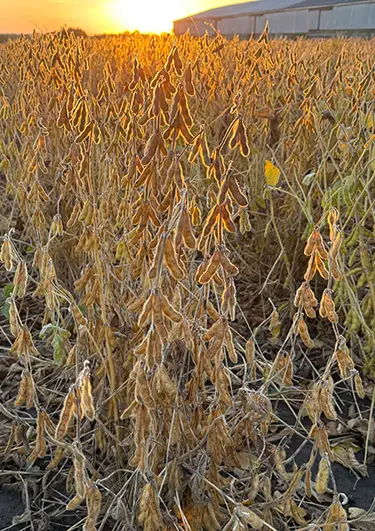
Most of the beans are in the bin, and plot data is rolling in; now is a good time to review 2026 and start lining up soybean acres for next spring. The Renk soybean lineup runs from 0.1 to 3.9 maturity, with 27 Enlist E3® products and 7 XtendFlex® products, and 14 of them carry the new tag on the chart.
Every soybean on the chart has to earn its spot in the plots. Renk research, dealer, and grower plots across Wisconsin, Minnesota, Michigan, Iowa, Illinois, and the Dakotas put these varieties side by side with each other and with competitive beans.
2026 Observations
Renk soybean plots were harvested at 92 locations in 2026, from North Dakota and western Minnesota down through Wisconsin, northeast Iowa, northern Illinois and Michigan’s Thumb. Across all those plots, yields averaged about 66 bushels with harvest moisture right around 12%. The best numbers came from southern Wisconsin, northern Illinois, and Iowa, where several plots averaged more than 80 bushels, with the top Renk entries pushing past 90. Western Minnesota, the Dakotas and parts of Michigan had a tougher year, with a few plots finishing in the 30s and 40s.
The headline is that the new varieties stormed into the lineup. We’ve never had a rookie class as high performing.
G0710E: Brings G0800E-type yield with a class-leading IDC rating.
G1110E: Brought on to deliver yields in line with G1260E, the yield champion. It did just that, showing an advantage in the Red River Valley and liking the eastern plots. It is best in class IDC and carries the Peking gene for cyst issues.
RS167E: Its numbers are not as flashy as expected; it shows a very clear advantage in Wisconsin and Michigan over G1560E, the maturity yield leader.
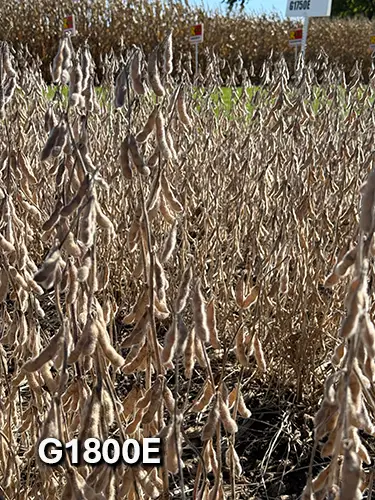
G1800E: Put up giant yield numbers as an experimental last year and matched them this year. We are seeing +3bu/acre over G1980E and G2150E. Couple this with elite white mold tolerance and this will be a hard one to ignore.
G1910E: Put up stronger numbers than G1800E the prior year in research but was slightly behind it this year. Still head and shoulders above older products. IDC and SDS scores make it compelling for western acres.
G2210E: Yield is coming in at +4.9 bushels over G2150E in plots! It’s holding its ground against G2300E in Iowa and Minnesota.
G2410E: Is the big gorilla for yield. It is 31W-17L versus G2300E, which had another outstanding year. +4.4 bushels against RS2480E. A must have for this maturity group.
G2710E: Yield data is slightly better than G2900E, RS266E, and G2480E. A tough trifecta to beat.
G3000E: Very strong when planted in its proper maturity. Many of our plots are on the early side for it.
G3210E: The one to beat in the early- to mid-group 3 lineup. Dominates competitors.
G3610ES, G0200E, and G0510E: Not enough plot data at this writing.
Maturity Placement
Early (0.1 to 0.9): G0180E brings a bulletproof disease package, and the new G0200E adds about a bushel and a half on top of it. New G0510E packs a lot of yield for a 0.5 and is a salt excluder, and new G0710E is the iron deficiency chlorosis leader in the group. G0750E dominates western acres, and G0800E brings strong white mold and brown stem rot tolerance for Wisconsin and Michigan, plus chlorosis and sudden death syndrome tolerance for the west. These fit northern Minnesota, North Dakota, and northern Wisconsin.
Early to mid 1s (1.0 to 1.6): G1110E is putting up a strong case to be the “go to” bean on the early side, especially in IDC and cyst-prone soils. G1260E will not go quietly since many people love it for its ability to move south and its proven yield track record. G1560E is strongest west of the Mississippi, and RS166E is expected to shine east of it.
Late 1s (1.7 to 1.9): G1800E and G1910E are vying for dominance in this maturity group. We carry both varieties and can be the 1-2 punch on customer acres. G1800E has shown consistent yield east to west in both years of our own testing. G1910E was more dominant west in 2025 but more dominant east in 2026. My hypothesis for this is that the G1910E performs best under drier conditions.
Each has specific acres where it’s the clear choice. White mold resistance is G1800E’s calling card, while IDC and sudden death-prone acres should use G1910E.
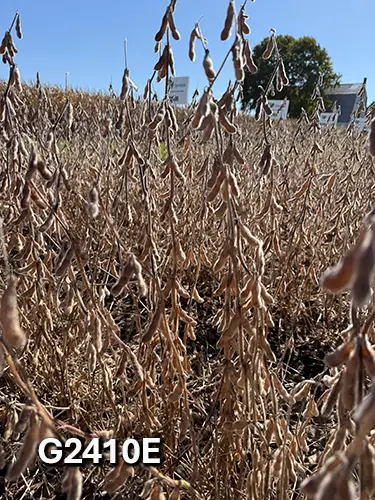 Early to Mid 2s (2.0 to 2.4): This is such a high-yielding group that it’s hard to go wrong with any of them. Hard to ignore the dominance of G2300E the last two years, but G2410Es are showing even better numbers with improved scores on SDS and white mold. G2210E is on the early side, with the bonus of the Peking gene for those high-cyst soils.
Late 2s (2.5 to 2.9): This group is very tight in yield across the board. I still like RS266E a lot on the early side until we get a longer track record with G2710E. The caution with RS266E is for known white mold acres. G2710E can be worked into the lineup in acres where G2900E is too late.
Group 3s (3-3.8): The choice here will be driven more by actual maturity wanted. G3000E is an exceptional product when in its proper maturity. G3210Es may have the most yield potential among G3000E, G3210E, and G3610ES. G3610ES adds the STS option, and G3890E still looks like the one to beat on the late side.
Picking the Right Fit
Start with maturity. The adaptability map in the seed guide shows each zone, and a variety moved north or south of its zone will change how it matures and how tall it gets. From there, look at what has limited yield on that field and match it to the disease ratings and Phytophthora gene on the chart.
Soybean cyst nematode deserves a closer look this winter. Iowa State reports that nematode populations across the Midwest have adapted to PI 81788 resistance, and recommends rotating PI 81788 varieties with Peking varieties rather than using one source every time. The Renk lineup has Peking options in G1110E, G1980E, G2210E, and G3000E. Then pick the herbicide system, Enlist E3® or XtendFlex®, and the seed treatment, either the Defender Package or the SDS Package on fields with a sudden death syndrome or nematode history.
Planning Your 2027 Soybean Acres
- Plant more than one variety. Spreading maturities lowers risk and widens the harvest window.
- Pull soil samples for soybean cyst nematode this fall. Knowing the numbers makes it easier to decide when to switch to Peking.
- Put white mold tolerance where the canopy closes fast. Narrow rows, high populations, irrigation and fields with a history of white mold are where it matters most.
- Match chlorosis tolerance to high-pH ground. On western acres, this rating often decides the field before yield does.
Looking Ahead to 2027
From far-north 0s to full-season 3s, the Renk soybean lineup has a bean for nearly every acre. Talk with your Renk dealer or DSM to match products to your fields and your field history.
References
- Iowa State University Extension and Outreach, Integrated Crop Management. Soybean Cyst Nematode-resistant Soybean Varieties for Iowa in 2027.
https://crops.extension.iastate.edu/cropnews/2026/10/soybean-cyst-nematode-resistant-soybean-varieties-iowa-2027 - University of Wisconsin Division of Extension, Nutrient and Pest Management. Integrated Approaches to White Mold Management.
https://extension.soils.wisc.edu/wcmc/integrated-approaches-to-white-mold-management/ - Michigan State University Extension. Bulletin E-3431: How to Read a Seed Guide (Soybean Edition).
https://www.canr.msu.edu/resources/bulletin-e-3431-how-to-read-a-seed-guide-soybean-edition