RK2622PCE — 82 RM
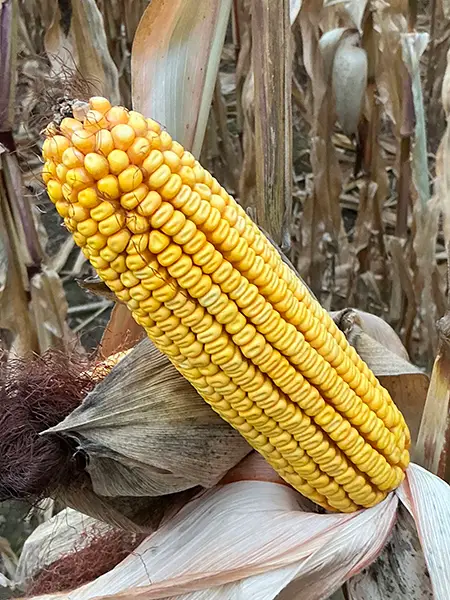
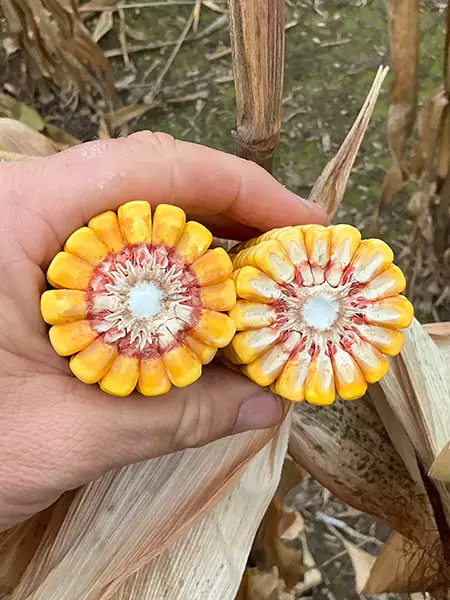 RK2622PCE is a new 82 RM PowerCore® Enlist® Refuge Advanced® hybrid with strong drydown and broad east-to-west adaptability. Its official profile carries 8 ratings across high-, medium-, and low-yield environments, as well as coarse and fine soils. Emergence, vigor, stalks, roots, and drydown are also rated 8. Recommended population is 30,000–34,000+ plants per acre, fitting its semi-determinate ear type and early-maturity positioning.
The 2026 notes highlight its early finish, with an ultra-early appearance at Staples, MN, and a sharp early-product look in Menomonie, WI. Kernel rows are commonly 14 to 16 around, although row number is lower at an extreme-stress location. Gary, MN, shows limited ear flex, while several locations maintain favorable stalk and root condition. These observations support using an appropriate stand rather than depending on large ear flex to compensate.
The season also sharpened the stress-placement discussion. Buffalo, ND, shows declining late-season intactness under extreme stress, while Kinde, MI, notes substantial tip-back and a less favorable stress response. These observations warrant more caution on the toughest acres than the broad official ratings alone might suggest. Short or loose husks and exposed tips are also noted. Tar spot, northern leaf blight, and southern rust are rated 6, with fungicide response rated 8.
Best fit: Early-maturity rotated acres across coarse and fine soils, with particular attention to fields that support establishment and a dependable finish.
Management focus: Use 30,000–34,000+ plants per acre, match population to field potential, and avoid assuming large ear flex will offset a reduced stand. Favor favorable-pH fields, scout disease, and monitor ear finish and plant condition on extreme-stress acres.
RK2645RR / RK2645 — 83 RM
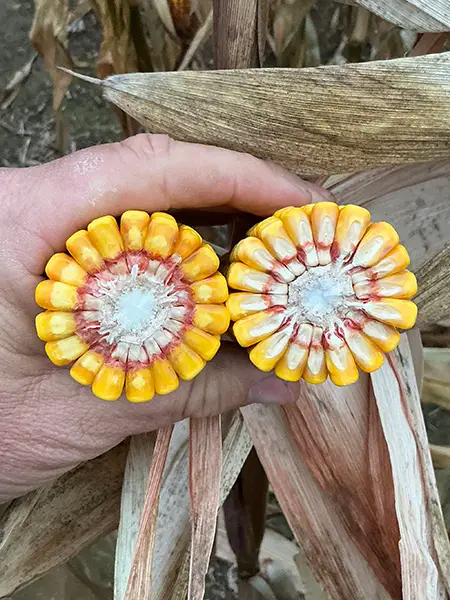
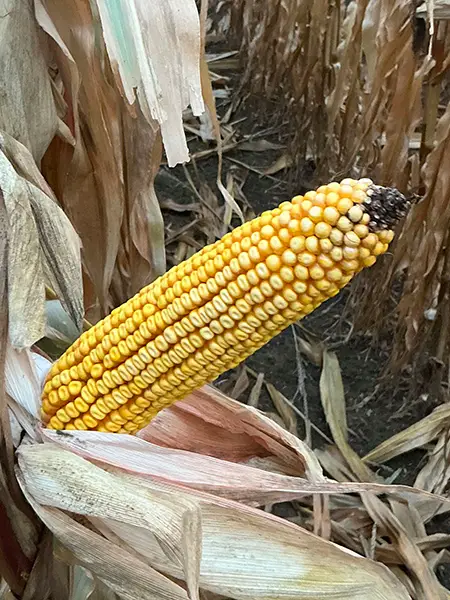
RK2645RR and RK2645 bring flexible ears, good grain quality, and dependable standability to the 83 RM range, available as a Roundup Ready® Corn 2 hybrid or conventional hybrid. In 2025 research,
both averaged 185.5 bu/ac at 20.0% moisture across 16 locations, with 56.1 lb/bu test weight and no measured stalk or root lodging. Medium- and low-yield environments are rated 8, as are coarse and fine soils. Recommended population
is 28,000–34,000 plants per acre.
The 2026 observations repeatedly support the early-product and grain-quality story. RK2645RR shows a sharp appearance and good ear size and flex at Manitowoc, WI, with favorable row appearance in Marshfield, WI. RK2645 is noted as a strong early option at Gary, MN, and shows good ear size for its maturity at Tigerton, WI. Commonly 16 kernel rows, and stalk and root condition are favorable across many entries.
Ear expression varies with stress and location. Zippering and tip-back are noted for the conventional entry at
the Marshfield, WI location. Tar spot and southern rust are rated 5, with fungicide response rated 8, supporting
a timely disease-management plan on risk acres.
Best fit: Early-maturity rotated acres, especially medium- to lower-yield environments across coarse and fine soils, where a Roundup Ready® Corn 2 or conventional offering fits the operation.
Management focus: Use 28,000–34,000 plants per acre, match population to field potential, and scout tar spot and southern rust. Monitor exposed tips, ear finish, and field condition, and keep harvest timely where needed.
RK3678VT4PRO / RK3678TRE — 90 RM
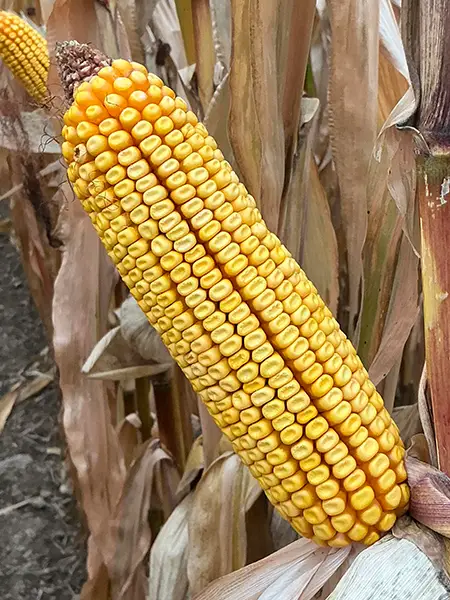
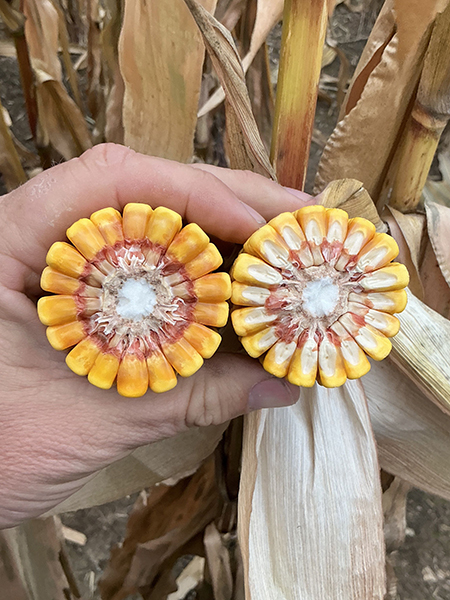
RK3678VT4PRO and RK3678TRE bring strong yield potential and reliable early-season growth to the 90 RM range, available as a VT4PRO™ RIB Complete® corn blend or Trecepta® RIB Complete® corn blend. A compact to moderate plant with lower ear placement and broad soil adaptability supports northern Corn Belt placement. High- and medium-yield environments are rated 9, with coarse and fine soils rated 8. Recommended population is 30,000–34,000+ plants per acre. VT4PRO provides an early below-ground trait option and carries a corn-on-corn rating of 8, compared with 6 for the Trecepta offering.
The 2026 observations highlight favorable row appearance, consistent ear placement, and commonly 16-row ears in both offerings. An important callout is the improved plant health and finish observed with RK3678VT4PRO in selected comparisons. At Menomonie, WI, its stay-green rating is 8 compared with 6 for RK3678TRE. At New Effington, SD, the VT4PRO entry is described as looking strong, while the Trecepta entry shows poor ear size. These observations point to a useful health-and-finish advantage in these environments, rather than a uniform response at every location.
Both offerings should be managed through the finish. Their official stay-green ratings are the same at 7, and tar spot and northern leaf blight are rated 6, with fungicide response rated 8. The observed VT4PRO improvement should be treated as field feedback—not proof that the trait directly increases disease tolerance.
Best fit: Productive northern acres across coarse and fine soils, especially medium- to high-yield environments. Favor rotated acres for RK3678TRE; include select managed corn-on-corn fields for RK3678VT4PRO.
Management focus: Use 30,000–34,000+ plants per acre, match the trait offering to field needs, and consider the observed VT4PRO health-and-finish improvement in placement discussions. Scout leaf disease, monitor stalks and ear retention, and maintain a timely harvest plan.
RK4656PCE — 93 RM
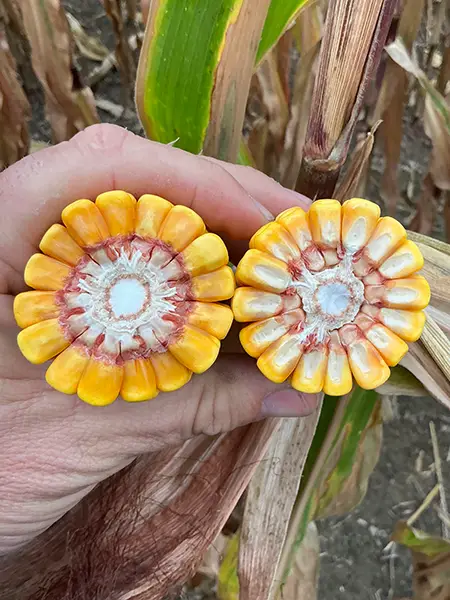
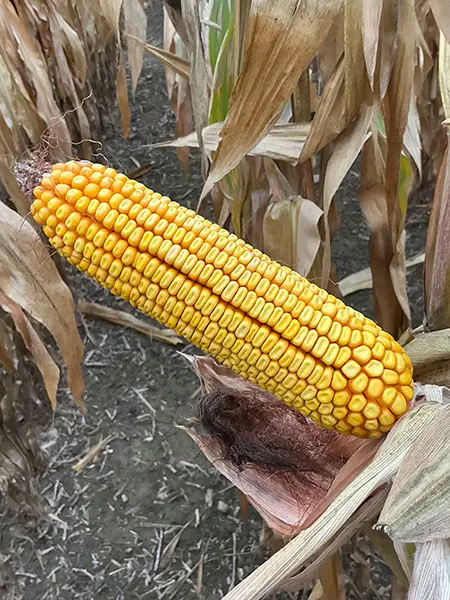 RK4656PCE is a new 93 RM PowerCore® Enlist® Refuge Advanced® hybrid with large, girthy ears and excellent flex. In 2025 research, it averaged 213.4 bu/ac at 20.9% moisture across 23 locations and ranked fourth in its set, with low measured stalk and root lodging. Medium- and low-yield environments are rated 9, while coarse and fine soils are rated 8. Recommended population is 28,000–34,000 plants per acre, allowing growers to match its flexible ear type to field potential. It also offers grain-and-silage use.
The 2026 notes repeatedly supports the ear-size and flex story. Several locations show large, girthy ears, commonly with 18 rows and occasionally 20. Sherburn, MN, and New Effington, SD, highlight strong ear flex, while Stewartville, MN, shows a sharp late-season appearance. Plants often express a moderate to bulky structure, a wide canopy, and lower ear placement. Many locations show favorable stalk conditions through
the finish.
Stress affected ear finish at some locations, with tip-back or zippering noted where heat or moisture stress intensified. These observations support keeping population matched to field potential rather than pushing
the ear-flex advantage too hard. Southern rust is rated 6 and fungicide response 7, while the high-pH rating
of 5 reinforces favorable-pH placement.
Best fit: Rotated grain or silage acres across coarse and fine soils, especially medium- to lower-yield environments where ear flex and moderate populations fit the operation.
Management focus: Use 28,000–34,000 plants per acre, match population to field potential, and favor favorable-pH ground. Scout southern rust, monitor ear shanks and husk condition, and check root support where wind or late-season conditions challenge harvestability.
Looking Ahead to 2027
These four product options complete our new-product series with distinct choices in the 82–93 RM range.
The opportunity is to combine the product profile and research foundation with this season’s field observations to place each hybrid where it can express its potential.
Use the 2026 learnings to refine population, match trait offerings to field needs, target disease management, and plan harvest around field conditions. One difficult season adds perspective—it does not replace the broader placement picture.