
ARTICLES

Preserving Every Pound: The Power of Inoculants in Silage Success

Season 1, Episode 3 
Preserving Every Pound: The Power of Inoculants in Silage Success

How do you protect your silage investment from the moment it’s chopped to the day it’s fed? In this episode, Max sits down with Alex Renk and Jesse Thompson of Arm & Hammer to dig into the science and strategy behind using inoculants.From the history of microbial preservation to today’s cutting-edge strain technologies, they explore how inoculants boost digestibility, reduce spoilage, and maximize dry matter retention. Whether you’re a dairy or beef producer, learn how this small additive can drive big returns and prevent your feed from going to waste. Maintaining is gaining, here’s how to get it right.

Background (spoiler alert: there’s alcohol involved!)

We think of silage inoculants as a newly invented product, which to a certain extent they are. But the roots of inoculants are almost as old as the history of mankind itself. What is entwined with the history of mankind other than the use of fire? Alcohol!

In the old days, the simple act of drinking water was life threatening. Water is a great carrier of diseases, bacteria and other nasty parasites. The limited supply of clean water put a lot of pressure on the survival of early mankind. At some point, someone discovered that letting various fruit juices ferment then convert a portion of itself into alcohol made the juice safe and kept it safe for an extended period of time.

Alcohol is really good at killing bacteria and smaller parasites...the amount we ingest is normally below dangerous levels.

Alcohol is really good at killing bacteria and smaller parasites. It can kill us too, but the amount we ingest is normally below dangerous levels. Suddenly, humans could walk around with goat skins full of alcoholic juice and drink without dying. This opened the door for people to spread into areas far from clean water. More importantly, it allowed people to settle in one spot and start farming, which is something we are a little partial to. It was a game changer.

Somewhere along the line, mankind took this a step further. Using bacteria to convert this alcohol into acetic acid and by adding salt they created vinegar. The combination of acid and salt was an excellent solution to preserve food for longer periods of time.

Silage inoculants are a new use for this ancient technology. At its simplest, lactic acid producing bacteria are added to the raw forage. They were selected to out-compete other bacteria and yeasts and create lactic acid. This in turn drops the pH level. During this process, as long as the forage is properly ensiled, the bacteria use up the available oxygen. Once the oxygen is used up and the pH has dropped to 4, the forage will remain stable and preserved until it is fed out.

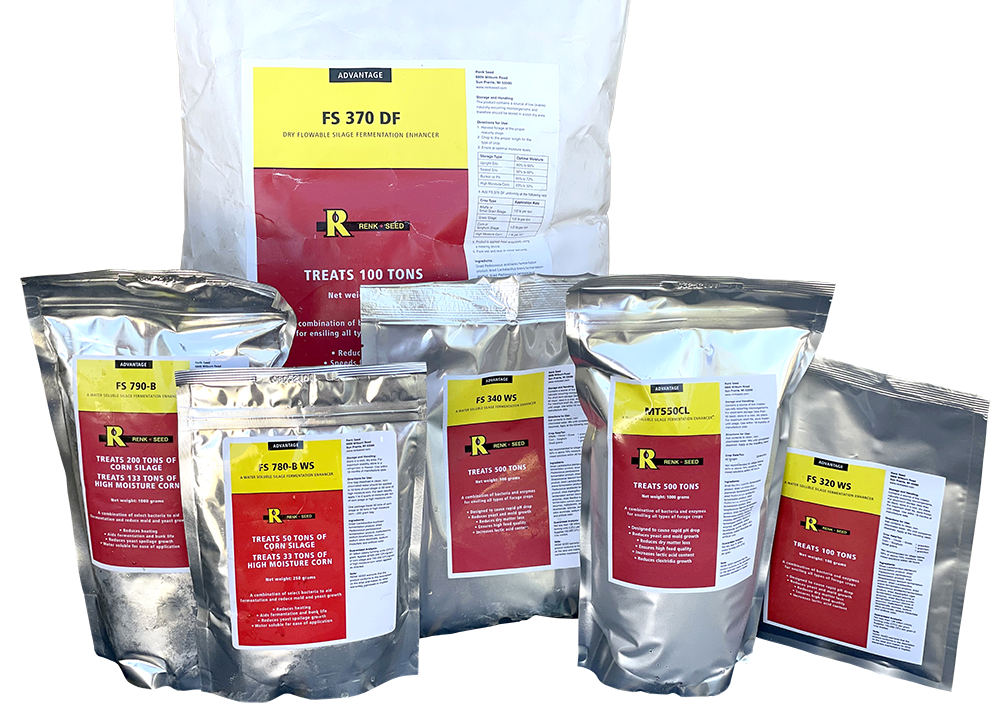
All Renk products use these lactic acid producing bacteria in their mix. In fact, we use several strains that are geared for different pH levels to maintain the rapid drop to stability.
advantage inoculantsLet’s take a deeper dive.

When you harvest your forage crop, it is at its peak energy content. Left to its own devices it will be consumed by yeasts and bacteria until nothing is left. Nature is pretty aggressive when it comes to recycling. Watch one of those creepy sped up movies of a mouse decaying to see it in action!

The quicker the bacteria do their job then the less exposure to energy loss the forage will have. Using the bacteria shortens the drop from 14 days to 4 days and we expect to see a savings of 3-5%+ in reduced losses.

Another benefit of these bacteria is they can digest some of the indigestible components of the plant structure. This increases the available energy and digestibility of the crop and does not rely on the animal’s rumen to do all the work. Our HM 780B and HMC 790B excel at this with high moisture corn.

Another benefit of these bacteria is they can digest some of the indigestible components of the plant structure. This increases the available energy and digestibility of the crop and does not rely on the animal’s rumen to do all the work. Our HM 780B and HMC 790B excel at this with high moisture corn.

Another benefit of these bacteria is they can digest some of the indigestible components of the plant structure.

The buchneri based inoculants also have benefit for feed out. Our HM 780B and HMC 790B contain buchneri generating bacteria that will prevent yeast growth when oxygen is reintroduced into the forage, such as an exposed bunker face. This will help prevent losing a portion of the crop to spoilage or prevent giving spoiled feed to your animals and putting stress on their digestive system.

One other product we offer, MT550CL, adds a bacteria that suppresses clostridium growth. This normally occurs when the crop is harvested at very high moisture (>65%).

Forage inoculants are a cost-effective way to help maximize return per acre, no matter what the conditions you face in the field. It’s only been several thousand years in development!