The Earfull November 9, 2026
Renk Soybean Lineup: What We Saw in 2026
Yield, disease packages, and placement: tested where soybeans are grown.
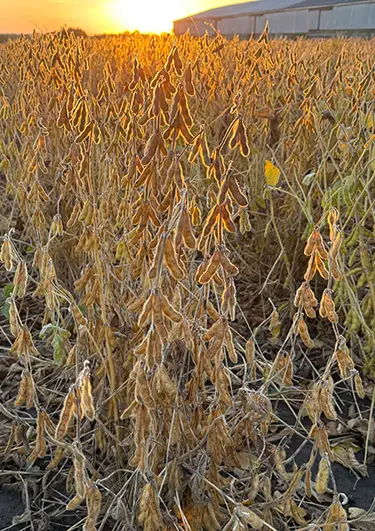
Most of the beans are in the bin, and plot data is rolling in; now is a good time to review 2026 and start lining up soybean acres for next spring. The Renk soybean lineup runs from 0.1 to 3.9 maturity, with 27 Enlist E3® products and 7 XtendFlex® products, and 14 of them carry the new tag on the chart.
Every soybean on the chart has to earn its spot in the plots. Renk research, dealer, and grower plots across Wisconsin, Minnesota, Michigan, Iowa, Illinois, and the Dakotas put these varieties side by side with each other and with competitive beans.
2026 Observations
Renk soybean plots were harvested at 92 locations in 2026, from North Dakota and western Minnesota down through Wisconsin, northeast Iowa, northern Illinois and Michigan’s Thumb. Across all those plots, yields averaged about 66 bushels with harvest moisture right around 12%. The best numbers came from southern Wisconsin, northern Illinois, and Iowa, where several plots averaged more than 80 bushels, with the top Renk entries pushing past 90. Western Minnesota, the Dakotas and parts of Michigan had a tougher year, with a few plots finishing in the 30s and 40s.
The headline is that the new varieties stormed into the lineup. We’ve never had a rookie class as high performing.
G0710E: Brings G0800E-type yield with a class-leading IDC rating.
G1110E: Brought on to deliver yields in line with G1260E, the yield champion. It did just that, showing an advantage in the Red River Valley and liking the eastern plots. It is best in class IDC and carries the Peking gene for cyst issues.
RS167E: Its numbers are not as flashy as expected; it shows a very clear advantage in Wisconsin and Michigan over G1560E, the maturity yield leader.
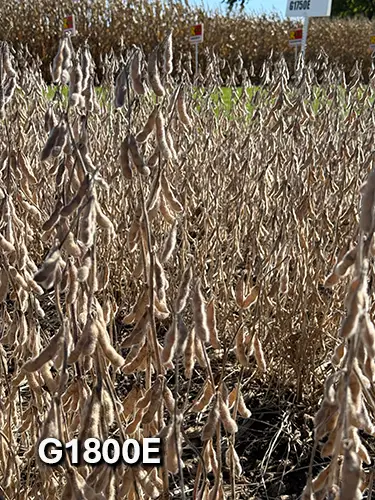
G1800E: Put up giant yield numbers as an experimental last year and matched them this year. We are seeing +3bu/acre over G1980E and G2150E. Couple this with elite white mold tolerance and this will be a hard one to ignore.
G1910E: Put up stronger numbers than G1800E the prior year in research but was slightly behind it this year. Still head and shoulders above older products. IDC and SDS scores make it compelling for western acres.
G2210E: Yield is coming in at +4.9 bushels over G2150E in plots! It’s holding its ground against G2300E in Iowa and Minnesota.
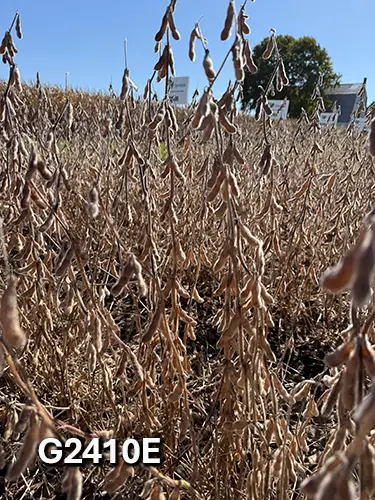
G2410E: Is the big gorilla for yield. It is 31W-17L versus G2300E, which had another outstanding year. +4.4 bushels against RS2480E. A must have for this maturity group.
G2710E: Yield data is slightly better than G2900E, RS266E, and G2480E. A tough trifecta to beat.
G3000E: Very strong when planted in its proper maturity. Many of our plots are on the early side for it.
G3210E: The one to beat in the early- to mid-group 3 lineup. Dominates competitors.
G3610ES, G0200E, and G0510E: Not enough plot data at this writing.
Maturity Placement
Early (0.1 to 0.9): G0180E brings a bulletproof disease package, and the new G0200E adds about a bushel and a half on top of it. New G0510E packs a lot of yield for a 0.5 and is a salt excluder, and new G0710E is the iron deficiency chlorosis leader in the group. G0750E dominates western acres, and G0800E brings strong white mold and brown stem rot tolerance for Wisconsin and Michigan, plus chlorosis and sudden death syndrome tolerance for the west. These fit northern Minnesota, North Dakota, and northern Wisconsin.
Early to mid 1s (1.0 to 1.6): G1110E is putting up a strong case to be the “go to” bean on the early side, especially in IDC and cyst-prone soils. G1260E will not go quietly since many people love it for its ability to move south and its proven yield track record. G1560E is strongest west of the Mississippi, and RS166E is expected to shine east of it.
Late 1s (1.7 to 1.9): G1800E and G1910E are vying for dominance in this maturity group. We carry both varieties and can be the 1-2 punch on customer acres. G1800E has shown consistent yield east to west in both years of our own testing. G1910E was more dominant west in 2025 but more dominant east in 2026. My hypothesis for this is that the G1910E performs best under drier conditions.
Each has specific acres where it’s the clear choice. White mold resistance is G1800E’s calling card, while IDC and sudden death-prone acres should use G1910E.
 Early to Mid 2s (2.0 to 2.4): This is such a high-yielding group that it’s hard to go wrong with any of them. Hard to ignore the dominance of G2300E the last two years, but G2410Es are showing even better numbers with improved scores on SDS and white mold. G2210E is on the early side, with the bonus of the Peking gene for those high-cyst soils.
Late 2s (2.5 to 2.9): This group is very tight in yield across the board. I still like RS266E a lot on the early side until we get a longer track record with G2710E. The caution with RS266E is for known white mold acres. G2710E can be worked into the lineup in acres where G2900E is too late.
Group 3s (3-3.8): The choice here will be driven more by actual maturity wanted. G3000E is an exceptional product when in its proper maturity. G3210Es may have the most yield potential among G3000E, G3210E, and G3610ES. G3610ES adds the STS option, and G3890E still looks like the one to beat on the late side.
Picking the Right Fit
Start with maturity. The adaptability map in the seed guide shows each zone, and a variety moved north or south of its zone will change how it matures and how tall it gets. From there, look at what has limited yield on that field and match it to the disease ratings and Phytophthora gene on the chart.
Soybean cyst nematode deserves a closer look this winter. Iowa State reports that nematode populations across the Midwest have adapted to PI 81788 resistance, and recommends rotating PI 81788 varieties with Peking varieties rather than using one source every time. The Renk lineup has Peking options in G1110E, G1980E, G2210E, and G3000E. Then pick the herbicide system, Enlist E3® or XtendFlex®, and the seed treatment, either the Defender Package or the SDS Package on fields with a sudden death syndrome or nematode history.
Planning Your 2027 Soybean Acres
- Plant more than one variety. Spreading maturities lowers risk and widens the harvest window.
- Pull soil samples for soybean cyst nematode this fall. Knowing the numbers makes it easier to decide when to switch to Peking.
- Put white mold tolerance where the canopy closes fast. Narrow rows, high populations, irrigation and fields with a history of white mold are where it matters most.
- Match chlorosis tolerance to high-pH ground. On western acres, this rating often decides the field before yield does.
Looking Ahead to 2027
From far-north 0s to full-season 3s, the Renk soybean lineup has a bean for nearly every acre. Talk with your Renk dealer or DSM to match products to your fields and your field history.
References
- Iowa State University Extension and Outreach, Integrated Crop Management. Soybean Cyst Nematode-resistant Soybean Varieties for Iowa in 2027.
https://crops.extension.iastate.edu/cropnews/2026/10/soybean-cyst-nematode-resistant-soybean-varieties-iowa-2027 - University of Wisconsin Division of Extension, Nutrient and Pest Management. Integrated Approaches to White Mold Management.
https://extension.soils.wisc.edu/wcmc/integrated-approaches-to-white-mold-management/ - Michigan State University Extension. Bulletin E-3431: How to Read a Seed Guide (Soybean Edition).
https://www.canr.msu.edu/resources/bulletin-e-3431-how-to-read-a-seed-guide-soybean-edition
The Earfull September 7, 2026
What is This Crop Telling Us?
The combine gives us the final yield number. A walk through the field before harvest helps explain why. This is the time to look for premature plant death, weak stalks, diseased roots, and the field patterns behind them.
Corn: Ghosted Plants and Dead Tops
Scattered corn plants that look gray-green, brown, or finished well ahead of their neighbors are often called “ghosted” plants. They may point to crown rot, stalk rot, or both. Do not diagnose them from the road—dig plants, keep the root ball intact, and split the lower stalk through the crown.
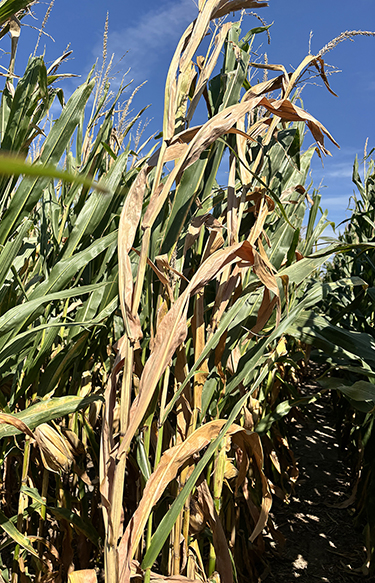
A rotted, brown-to-black crown; discolored roots; deteriorated pith; or weak lower internodes all point to a standability concern. These issues often start much earlier than when symptoms appear. Cool or wet soils, slow emergence, compaction, restricted roots, nutrient stress, saturated areas, and late grain-fill demand can all leave plants more vulnerable.
Also look up in the canopy. Scattered plants with a dead flag leaf and browned leaves or stalk above the ear may have anthracnose top dieback. It can resemble ghosting because the plant is dying early, but the top-down pattern is the clue. The upper portion of the plant dies while leaves around the ear or lower in the canopy may remain green.
Peel back upper leaf sheaths on suspect plants. Shiny black, elongated lesions on the stalk rind support an anthracnose diagnosis. Check the lower stalk, too. Top dieback often occurs with stalk rot, and a dead top alone does not tell you whether the plant will lodge.
Not every brown plant or dead top is disease. Heat and drought can kill upper leaves, often across a larger dry area of the field. Insect injury and other stresses can look similar. Compare affected plants with healthy neighbors, split stalks, and send samples for diagnosis if the cause is uncertain.
Let standability set harvest order
There is no late-season rescue treatment. The immediate priority is to identify fields most likely to lodge and put them ahead of stronger fields in the harvest plan. Begin near black layer and walk each field. At five or more stops, use both a pinch test on the lower internodes and a push test: push plants about 30 degrees from vertical and see whether they return upright.
A field with roughly 10% failed plants deserves attention and should be scheduled early. At 10–15% failed plants—or where crown rot, shredded pith, weak lower nodes, or lodging is concentrated in meaningful acres—move that field to the front of the line. Do not let a field with compromised stalks wait for the calendar just because grain is drying down well. Wind, rain, and continuing stalk decline can turn a manageable problem into ears on the ground.
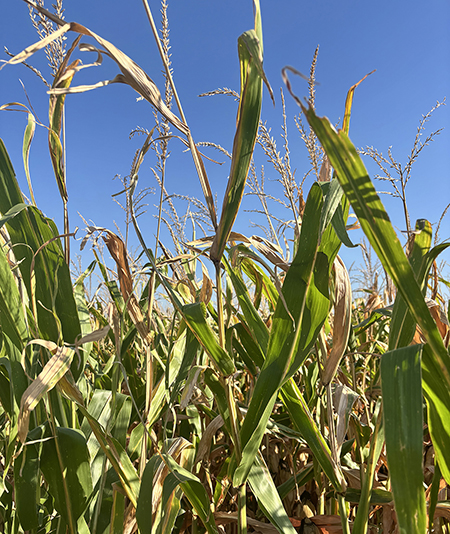
When a high-risk field reaches physiological maturity, it can be worth taking it at approximately 20–25% grain moisture and drying it rather than waiting for ideal field-drydown moisture. The drying bill has to be weighed against lost ears, slower harvest, extra header loss, and the time required to pick up lodged corn.
If a weak field is already below 20% moisture, the margin for waiting is usually gone. Grain is not gaining meaningful drydown value fast enough to justify increased lodging exposure, and dry, weakened stalks can continue to fail. Harvest it as soon as logistics allow. Keep ground speed down in lodged spots, run the header close to the ground, and consider harvesting against the direction plants are leaning to reduce missed ears.
Record the hybrid, field location, soil conditions, drainage, population, fertility concerns, and severity while symptoms are still visible. Those observations help make better placement and management decisions next season.
Soybeans: SDS or Red Crown Rot?
Soybean plants with yellowing and browning between leaf veins are worth digging now. Sudden death syndrome and red crown rot can look similar from above the canopy, but the roots and lower stem help separate them.
Sudden death syndrome typically causes yellow areas between green veins that become brown and dead. As symptoms worsen, leaflets often drop while the petioles remain attached to the stem. Roots can be decayed, and blue fungal growth may sometimes be visible. Disease risk is often greater in fields with cool, wet planting conditions, compaction, poor drainage, or soybean cyst nematode pressure.
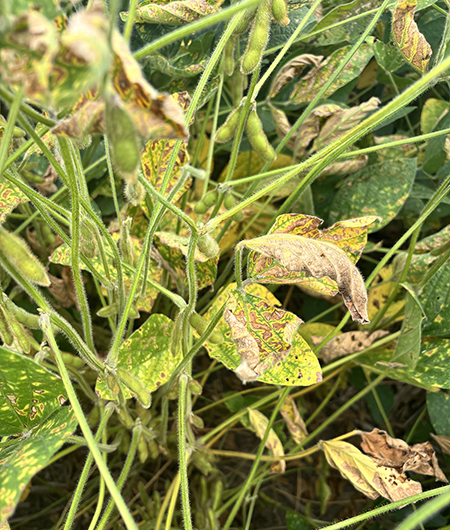
Red crown rot can cause similar interveinal yellowing and browning, but it more directly affects the roots and crown. Dig whole plants and inspect the lower stem at the soil line. Reddish discoloration at the stem base, severe root rot, and small reddish-brown fungal structures under favorable conditions are important clues. Unlike sudden death syndrome, plants affected by red crown rot often retain dead leaves.
Neither disease has an in-season cure. Flag affected areas and confirm red crown rot with a diagnostic lab, especially where it is new or suspected. For next year, use field observations to guide variety selection, soybean cyst nematode sampling and management, drainage and compaction improvements, and seed-treatment decisions. Crop rotation and avoiding movement of soil from suspect areas can help reduce red crown rot risk, but neither practice will erase a field history overnight.
Take Home
Every field tells a story. A few shovel digs, split stalks, standability checks, and notes before harvest can turn late-season symptoms into a better plan for hybrid placement, harvest timing, and disease management next year.
References
- Freije, A., Wise, K., & Nielsen, R. (2016). Diseases of corn: Stalk rots (BP-89-W). Purdue Extension. https://www.extension.purdue.edu/extmedia/BP/BP-89-W.pdf
- Adee, E., & O’Mara, J. (2026). Sudden death syndrome in soybeans: Symptoms, diagnosis, and management. K-State Research and Extension.
https://www.agronomy.k-state.edu/eupdates/2026/issue-1118-august-27/sudden-death-syndrome-in-soybeans.html - Camiletti, B. (2025). Red crown rot progressing in Illinois: Symptoms confirmed in Shelby County commercial fields. University of Illinois Department of Crop Sciences.
https://farmdoc.illinois.edu/field-crop-production/red-crown-rot-progressing-in-illinois-symptoms-confirmed-in-shelby-county-commercial-fields.html
The Earfull July 20, 2026
As Fungicide Season Moves from Discussion to Decision
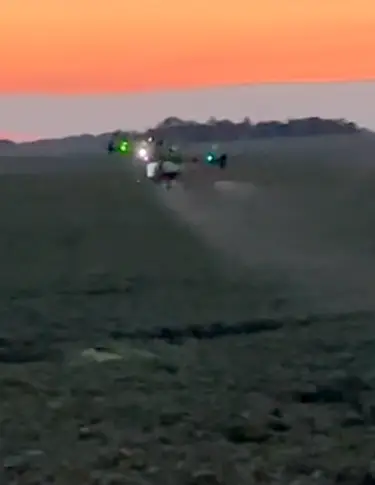
Across much of the Renk sales area, fungicide season in corn and soybeans is no longer a planning conversation. It is an active decision window. Some acres are already being sprayed. Others are being watched closely as fields move into tassel, early silking, flowering, and beginning pod. That makes this a good week to simplify the discussion. The question is not whether fungicides can work. The question is where they still fit, what conditions deserve quicker action, and which acres should probably not be forced into a pass just because the calendar says it is fungicide time.
This also feels like one of those weeks when general disease talk can outrun actual field conditions. That usually happens when the topic is timely and the crop is entering a sensitive stage. A better approach is to sort fields by crop stage, disease pressure, field history, and remaining yield potential. When those pieces line up, fungicide can still be one of the in-season management tools. When they do not, the recommendation gets harder to defend.

Corn
Corn should still get the first look in many geographies because a lot of acres are entering or approaching the highest-value fungicide window right now. The long-standing emphasis has been that the main leaves worth protecting are the ear leaf and the leaves above it, because those leaves contribute roughly 75 to 90 percent of the carbohydrates needed for grain fill. This is one reason tassel through early silking remains the practical decision window in so many agronomy conversations.
Start scouting immediately prior to tasseling. Check lower leaves up through the ear leaf. If disease is not present below the ear leaf, a fungicide application may not be warranted, and weekly scouting may be a better move than reacting too early. That fits the broader Midwest reality well. Fungicides are not especially forgiving when they are applied too early, and most products are effective for only about 14 to 21 days. Since corn still has a long stretch from silking to maturity, early sprays can lose value before the crop reaches its most important grain fill period.
A few corn checks matter right now
- Confirm actual crop stage by field, not just by windshield appearance.
- Start with corn-on-corn, higher-residue, and more disease-prone hybrid situations first, because those fields carry more foliar disease risk in a typical Midwest system.
- Watch whether lesions are staying well below the ear leaf or beginning to move into the part of the canopy that matters most during grain fill.
- Keep the duration of protection in mind. A spray made too early may not still be carrying enough activity when disease risk matters most.
Be realistic about field potential. Fungicide protects stronger corn better than it rescues stressed corn.
The main point in corn is still discipline. It is easy to talk a field into a fungicide application when disease discussion gets loud. It is more useful to ask whether the field has the disease setup, crop stage, and yield potential that give the pass a reasonable chance to return.
Soybeans
Soybeans deserve the same kind of discipline, even if the conversation usually trails corn. Across much of the region, the key soybean question is whether fields are moving into the R3 window with enough disease risk and enough yield potential left to justify a fungicide trip. That is usually a better question than simply asking whether fungicide is being applied nearby.
That matters in soybeans because fungicide decisions are often influenced by habit. A clean-looking field can still be treated because the operation usually sprays beans at a certain stage. But resistance-management principles argue for a more selective approach. Tank mixes with different modes of action, avoiding reduced rates, and keeping applications tied to real disease pressure are all part of protecting chemistry performance over time.
A few soybean checks matter right now
- Focus first on fields nearing the main reproductive fungicide window and with a history of foliar disease pressure.
- Prioritize fields where canopy density, field history, and longer periods of leaf wetness are more likely to support disease development.
- Keep scouting consistent enough that fungicide decisions are tied to incidence and severity, not just to habit or timing on the calendar.
- Avoid reduced rates and avoid leaning on the same mode of action repeatedly, especially where multiple passes are being discussed.
- Treat fungicide as a crop-protection tool, not an automatic bonus-bushel pass.
Soybean fungicide can still fit very well in the right fields. The better message this week is simply to stay selective. Build the recommendation from disease threat, field history, and crop stage rather than from routine alone.
What likely happens next
For the next seven to ten days, fungicide activity will likely remain in corn and continue to build in soybeans as more acres move into the reproductive window. The strongest near-term fit should remain in corn fields at tassel or early silking where foliar disease is present or likely to move into the upper canopy. Soybean decisions will stay more variable from one field to the next because disease development is often less uniform and stewardship matters more when pressure is not yet obvious.
This is why the most useful agronomy conversations right now are still the simpler ones. Rank fields. Confirm stage. Revisit field history. Decide where disease risk is real. Protect the acres that still have clear yield to defend. Then avoid turning fungicide timing into a routine trip in fields that don’t show enough evidence to support it.
References
- Before applying fungicides to corn: Stop! Look! Consider! — ear leaf protection, scouting before tassel, 14 to 21 day activity, corn-on-corn risk, and economics of fungicide use — Iowa State University Extension — crops.extension.iastate.edu
- Fungicide resistance management in corn, soybean, and wheat in Wisconsin — FRAC groups, resistance risk, scouting-based field history, alternating modes of action, and avoiding curative or reduced-rate use — University of Wisconsin Extension — corn.agronomy.wisc.edu
- Before applying fungicides to corn: Stop! Look! Consider! — hybrid susceptibility, disease position in the canopy, and why timing matters more than simply being early — Iowa State University Extension — crops.extension.iastate.edu
The Earfull June 29, 2026
Disease Triangle Building in Corn
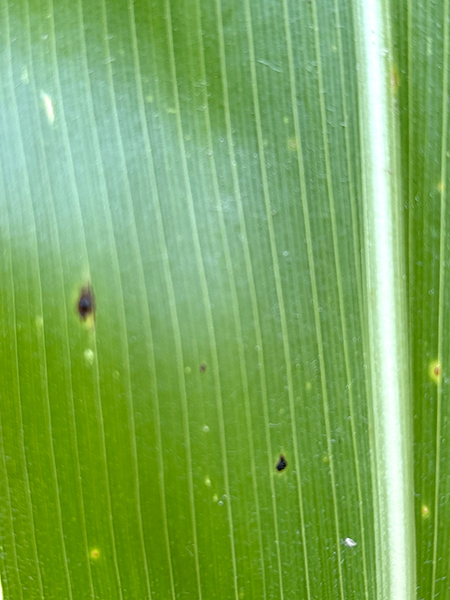
Corn disease risk is starting to organize around the classic disease triangle: a susceptible host, active inoculum, and favorable weather. In 2026, that conversation centers on tar spot first, with northern corn leaf blight, gray leaf spot, and other residue-driven foliar diseases also worth watching as more acres move toward rapid canopy closure and the pre-tassel period.
Tar spot has already been confirmed at low levels in parts of the region this season, which means inoculum is present. Fields with a previous history should move higher on the scouting list.
The weather setup over the next two weeks adds another layer of concern. The latest Climate Prediction Center outlook favors above-normal temperatures across much of the Corn Belt, while above-normal precipitation is favored across much of the Upper Midwest and Great Lakes region. This combination does not automatically mean a disease outbreak. It does increase the odds that leaf wetness, canopy humidity, and repeated moisture events begin to support disease development in the fields that already have the rest of the triangle in place.
Disease Triangle: Why This Matters Now
The disease triangle remains the simplest and best framework for making disease decisions in corn.
Disease pressure only builds when three pieces overlap:
- A host that can be infected.
- Inoculum present in or near the field.
- Weather favorable enough to support infection and spread.
In most Renk geographies, the host is already there, and the inoculum is no longer theoretical. For tar spot and northern corn leaf blight in particular, residue and local history matter. The swing factor in late June is weather, especially repeated rain, long dew periods, humidity, and canopy moisture that keeps leaves wet into the morning hours.
Tar spot is the disease drawing the most attention because it can move quickly once conditions turn favorable. Extension guidance for 2026 continues to emphasize that current early-season detections are low-incidence and low-severity. This is not a signal to make blanket fungicide applications on vegetative corn. That distinction matters. The right takeaway is not “spray now.” The right takeaway is “know which fields deserve tighter scouting intervals.”
What Could Be on Deck
Tar spot
Tar spot should remain the lead watch-out over the next two weeks. Heavy emphasis is on fields with a history of the disease, continuous corn, heavier residue, irrigation, or longer periods of canopy wetness. University guidance this season notes that findings have been at low incidence and severity in early vegetative corn, and that fungicide applications at these stages have generally not been economical. That means the practical response is targeted scouting and field ranking, not automatic treatment.
Northern corn leaf blight
Northern corn leaf blight warrants attention in fields with high residue and less-forgiving hybrids. It tends to move more effectively when leaf surfaces stay wet and humidity remains elevated. This is especially true as the crop approaches tassel and the canopy begins to hold moisture longer. If the coming pattern delivers repeated moisture without fast drying, this disease can move from background concern to active management discussion.
Gray leaf spot and other foliar disease pressure
Gray leaf spot remains on the “watch list” when warm, humid weather combines with residue and dense canopy conditions. It is rarely about one factor alone. It is usually the combination of field history, environment, and crop stage that determines whether disease remains cosmetic or begins threatening upper-canopy leaf area. The same logic applies to other common foliar diseases that can build when extended humidity and residue are part of the system.
What to Do Right Now
For the next two weeks, the highest-return management step is field prioritization.
Start with the fields most likely to move first:
- Corn-on-corn acres
- Fields with known tar spot or foliar disease history
- High-residue situations
- Irrigated fields or fields with prolonged overnight wetness
- Denser canopies that are beginning to hold humidity
- Acres approaching tassel sooner than the rest of the operation
Then, tighten scouting intervals in those fields. A practical approach is to avoid treating every field the same. A rotated field with lower residue and faster drying conditions does not need the same urgency as a pivot field with prior tar spot history and frequent leaf wetness.
Scouting should stay focused on lower-canopy and mid-canopy symptom development, but the real decision point is what is happening as fields approach VT and R1. If disease remains low in the canopy and pressure is limited, the best economic move may still be to wait. If favorable weather continues and disease begins threatening the upper canopy or ear-leaf zone, that is when fungicide conversations become more actionable.
Timing for Best ROI
Current multi-state extension guidance continues to support the idea that fungicide timing matters more than simply being early. For tar spot and other foliar diseases, the best return typically comes when applications are made in the VT to R3 window, not during early vegetative growth. Early applications may look proactive, but they often do not persist long enough to protect the crop during the most important grain-fill period and have generally not proven economically viable under university guidance for 2026 conditions.
A simple ROI framework:
- Too early: Disease is present at very low levels in vegetative corn, mostly low in the canopy, with limited immediate threat to the ear leaf or upper canopy.
- Best window: VT/R1 through R3 when disease is active, weather remains favorable, and the goal is to protect the upper canopy during the highest-value period.
- Lower return: Applications made after meaningful upper-canopy disease is already established often lose value quickly.
The best recommendation for growers is to match timing to risk, not anxiety. Protect acres most likely to respond, protect them in the window most likely to return, and avoid broad “insurance” passes that are not tied to field-level disease pressure or crop stage.
EARFULL Talking Point
The disease triangle is starting to form in 2026. Tar spot is already in the conversation, and the next two weeks look supportive enough to raise scouting priority across higher-risk corn acres. The best ROI move today is not automatic early fungicide. It is a strategic field ranking, closer scouting, and preparation to act in the VT/R1 to R3 window, where foliar disease protection has the best chance to pay.
References
- University of Nebraska-Lincoln CropWatch. “Making Fungicide Decisions for Corn and Soybean in 2026.”
https://cropwatch.unl.edu/making-fungicide-decisions-corn-and-soybean-2026/ - NOAA Climate Prediction Center. “6-10 and 8-14 Day Prognostic Discussions.” https://www.cpc.ncep.noaa.gov/products/predictions/610day/fxus06.html
- Cooperative Farmers Elevator. “2026 Crop Disease Outlook.”
https://www.coopfe.com/2026-crop-disease-outlook/
The Earfull April 27, 2026
Planting Into Marginal Conditions
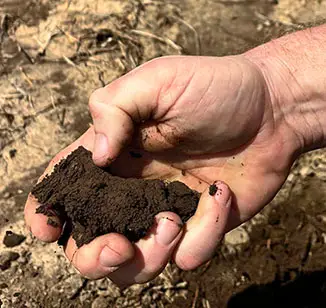
The planting window always tempts growers to push. The best risks are the ones that preserve stand establishment, not the ones that simply move the calendar ahead. University extension guidance consistently points to soil fit, short-term temperature trend, and emergence uniformity as the main factors that separate a smart early push from a preventable stand.
Corn can justify some early-planted risk when:
- Seed-zone soil temperature is at or near 50°F.
- The forecast is warming.
- The field is fit enough to avoid sidewall smearing or cloddy seedbeds.
In dry conditions, moving seed a bit deeper to reach uniform moisture can be worthwhile.
The risk is usually not worth planting into wet soils, planting just ahead of a cold rain, or planting in rough conditions causing variable seed depth. Corn is especially vulnerable during the first 24 to 48 hours after planting because cold water uptake can trigger imbibitional chilling, leading to weak or abnormal seedlings before the crop ever reaches the surface.
A practical way to frame corn decisions is simple:
- Take the risk when soils are fit, moisture is uniform, and temperatures are expected to hold or rise.
- Don’t take the risk when the field is tacky, sidewalls smear, or a cold rain is likely right after planting.
- Protect yield by chasing uniform emergence more than by chasing the earliest possible date.
Soybeans often reward timely early planting, but only when the first day after planting favors warm water uptake rather than cold shock. Iowa State still recommends planting soybeans into warm soils when temperatures are not expected to decrease during the first 24 hours. This is because the seed is most vulnerable during the first 12 to 24 hours of water uptake.
The risk potentially worth taking in soybeans is planting early into a fit field with a stable forecast, even if the calendar date feels aggressive. The risk typically not worth taking is planting into cool, wet, or saturated ground where crusting and oxygen stress can nearly wipe out emergence, especially in low areas or fields with uneven drying.
For both crops, the main question is not “Can the planter run?” but “Will the stand emerge evenly?” Corn pays a bigger penalty for uneven emergence, while soybeans generally tolerate stand variability better — unless gaps become large or emergence failures are severe.
Early Emergence Expectations
Once seed is in the ground, the next job is to separate patience from problems. Cool conditions slow emergence naturally. Scouting should focus on whether plants are progressing normally, uniformity of delays, and if symptoms point to crusting, chilling, disease, or seed-zone variability.
In corn, early emergence should be judged on both timing and uniformity. Purdue’s work shows yield loss grows when emergence spreads out. Full stands containing plants delayed by about 1.5 weeks lose roughly 6 to 8 percent, and delays of about 3 weeks become much more costly, especially when many plants are late.
Scout corn fields for:
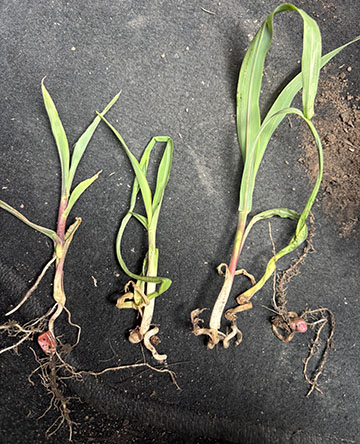
- Uneven height or leaf stage across the row, which often points to variable moisture, temperature, or seed placement.
- Corkscrewed mesocotyls or underground leafing out after cold stress.
- Plants trapped below a crusted surface, especially after hard rain on worked ground.
- Open seed furrows, sidewall compaction, or clod-related skips that trace back to planting into wet soils.
- A useful rule in corn is that uniform, slower emergence is usually less damaging than patchy emergence. If the whole field is slow because temperatures stayed cool, patience is often warranted; if neighboring plants are emerging far apart in stage, competition begins early and yield risk rises.
Soybeans deserve a different lens. Iowa State notes soybean cold injury can reduce vigor or kill seed before emergence, but soybean stands often tolerate some unevenness better than corn unless plant loss creates large holes.
Scout soybean fields for:
- Missing plants tied to seed death before emergence in cold, wet soils.
- Pale seedlings, slow hypocotyl pull, or emergence blocked by crusting.
- Swollen, weak, or rotted seedlings that suggest disease pressure in saturated conditions.
- Large gaps, especially those greater than about 2 feet, as this could lead to higher pressure later in the year.
Soybean emergence evaluation should emphasize surviving stand and gap pattern more than perfect visual uniformity. Iowa State notes soybean emergence uniformity very rarely causes enough yield loss by itself to justify replanting. Instead, the key is to confirm that enough healthy plants are present and the stand can canopy and compete.
Scouting priority for both crops:
Dig plants rather than guessing from the road. The first pass should check seed depth, moisture pattern, mesocotyl or hypocotyl condition, crusting, and whether the problem is random or tied to a soil type, tillage pass, residue band, or low spot.
Sources
- University of Minnesota Extension. “Strategies for Successful Corn Planting.” Accessed 2026.
https://extension.umn.edu/corn-planting/strategies-successful-corn-planting - Iowa State University Extension and Outreach – Integrated Crop Management. “Stand Establishment Critical for Early Planted Corn and Soybean.” Accessed 2026. https://crops.extension.iastate.edu/post/stand-establishment-critical-early-planted-corn-and-soybean
- Purdue University Extension. “Effects of Uneven Seedling Emergence in Corn (NCH-36).” Accessed 2026.
https://www.extension.purdue.edu/extmedia/nch/nch-36.html
The Earfull April 20, 2026
Early Season Insects—What to Look For
Planting season moves fast. By the time a stand problem is obvious, the window to act — or to explain it — has already closed. Early-season insects are one of the most common causes of uneven emergence, skips, and replant decisions, and they’re easy to miss if you’re not scouting at the right time.
Risk isn’t tied to one type of spring. Cool, wet soils slow germination and leave seeds in the ground longer, giving soil-dwelling pests more time to feed. But warm soils with heavy crop residue, manure applications, or recently terminated cover crops create their own risk by drawing egg-laying insects and supporting larval populations. Both scenarios show up regularly across the Renk sales area. Walking fields at or shortly after emergence — not just at canopy closure — is when these problems are catchable and explainable. Let’s review the key pest offenders:
Seedcorn Maggot (Corn and Soybeans)
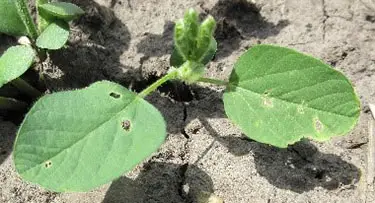
Seedcorn maggot is the larva of a small fly — pale yellow-white, legless, about ¼ inch long. Larvae feed directly on germinating seeds and young shoots before the plant ever breaks ground. Fresh organic matter is the main attractant. Fields with heavy residue, recent manure, incorporated cover crops, or freshly tilled green material carry the highest risk. Cool, wet soils compound the problem by slowing germination and extending the window larvae have to feed.
In the field, look for seeds that are hollowed out or show no viable shoot or root development. You’ll often find seedlings that started to emerge and then died at or just below the soil surface. Gaps and skips that don’t match planter performance data are a telltale sign, particularly in low-lying areas, field edges near manure application zones, or anywhere a cover crop was terminated late.
Wireworm (Corn and Soybeans)
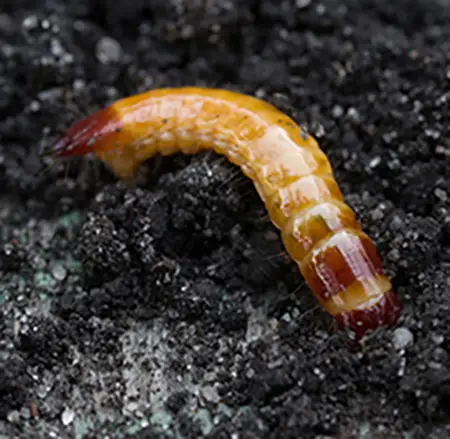
Wireworms are the larvae of click beetles — hard, shiny, orange-brown, and cylindrical, almost wire-like to the touch. They spend multiple years in the soil and feed on seeds and below-ground plant tissue. Sod ground is the classic red flag: former pasture, fields following small grains or perennial grasses, or any ground that’s been in long-term grass cover. First-year corn or soybeans after sod is the highest-risk scenario you’ll encounter.
Stand loss from wireworm tends to be patchy and irregular — not clean row skips, but odd sections or scattered holes in the field. Seeds will show entry holes or be hollowed out with the shoot or radicle chewed off. To confirm, dig 6 to 12 inches deep in problem areas; early in the season when soils are still cool, wireworms concentrate in the top few inches. Stunted, wilted, or dead seedlings where the underground stem is damaged, but the plant never fully emerged are a reliable indicator.
Black Cutworm (Primarily Corn; Occasionally Soybeans)
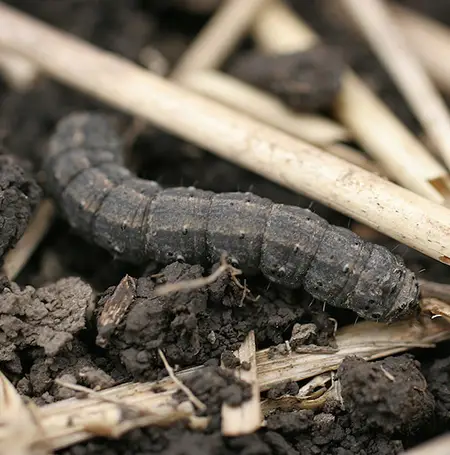
Black cutworm moths don’t overwinter in most of the Renk sales area — they migrate north on spring storm systems. Fields with winter annual weeds, heavy surface residue, or recently terminated cover crops are higher risk because they attract egg-laying moths. Corn from VE through V5 is the primary target. Soybeans can occasionally be clipped in a heavy year, but this is mainly a corn problem.
Watch for wilted or cut-off plants at or just below the soil surface, often in the first few rows from field edges or in weedy areas. Damage shows up in clusters or patches, not uniformly across the field. Before full cutting begins, you may see small, round feeding holes in leaves — that’s your early warning. When you find damage, dig in moist soil near the affected plants and look for the caterpillar itself: dark gray to black, curls into a C-shape when disturbed.
In soybeans, if pressure is unusually high, check for clipped stems or leaf feeding on early-emerged plants along field edges or in areas with residue. It’s uncommon, but worth a look in high-pressure years.
Quick Risk Overview:
No single field type has zero risk. The combination of field history — sod, cover crops, manure — residue levels, weed pressure, and spring weather determines where problems concentrate. Cool springs push seedcorn maggot and wireworm risk up. Warm springs with weedy fields and migrating storm fronts elevate black cutworm. Many fields carry more than one risk factor.
Take Home:
- Walk fields at emergence. Target fields with manure, high residue, cover crop history, sod ground, or known weed pressure first — these are your highest-risk acres.
- Dig before you diagnose. Skips and uneven emergence have many causes. Pull seeds and seedlings from problem areas and look for physical damage before attributing stand loss to cold stress or planter issues.
- Document what you find. Note field history, soil conditions, pest species observed, and estimated stand loss.
Early planting into cold soils increases seedcorn maggot and wireworm exposure. Late cover crop termination increases all three pest risks.
Sources:
- University of Wisconsin–Madison Extension — ipcm.wisc.edu
- Iowa State University Extension — crops.extension.iastate.edu
- Michigan State University Extension — canr.msu.edu/ipm
The Earfull April 13, 2026
Corn Seedling Diseases: When Mother Nature Overwhelms Even the Best Treatments
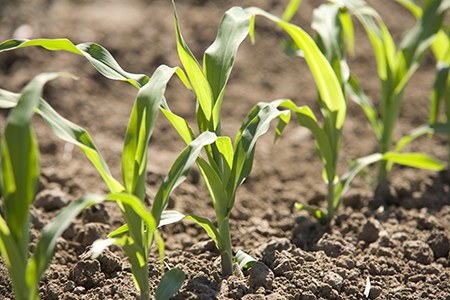
Renk Seed corn comes standard with industry-leading multi-mode seed treatment packages Metalaxyl, Fluoxastrobin, and Prothioconazole working together to protect your seedling from the moment it hits the soil. But some springs, Mother Nature tips the scales. Extended cold and wet soils after planting, or a warm saturated stretch right after emergence, can push disease pressure beyond what the seed treatment alone can fully hold back. That’s exactly why we introduced Resilient™ AP,
a planter box biological treatment designed to layer additional protection right at seeding, reinforcing root health and early vigor when conditions get tough.
The Three Main Corn Seedling Diseases
Pythium — The most common early-season threat. Thrives in cool, saturated soils (below 55°F) with standing or pooled moisture. Produces swimming spores that move through wet soil directly to the root. Infected seedlings have dark, slimy roots where the outer cortex peels away, leaving a white inner core. Seed that never emerged will be soft and rotted. Concentrated in low spots and poorly drained areas.
Fusarium — The opportunist. Covers a wider range of temperature and moisture conditions and follows plant stress, compaction, herbicide injury, temperature swings, or saturated soils. Shows up as tan to reddish-brown lesions on the mesocotyl and roots, sometimes with pink or salmon sporulation. Stressed plants invite it in; a clean planting environment keeps it at bay.
Rhizoctonia — The dry-side problem. Unlike the others, Rhizoctonia favors warmer, drier conditions and hits hardest in sandy or well-drained loam soils. Infected seedlings have firm, dry, reddish-brown lesions on the mesocotyl near the soil line, not mushy, not water-soaked. Often no obvious above-ground symptoms until the plant is stunted or chlorotic.
Resilient™ AP: Our planter box biological treatment adds beneficial microorganisms directly at seeding, colonizing the rhizosphere to compete with soilborne pathogens and support root development, extending your protection window beyond what the fungicide chemistry alone covers. In its launch year we will not have any additional supply for in-season needs.
How to Scout Corn Seedlings
Scout at emergence through V2, that’s your window before the plant either recovers or the evidence disappears. Walk problem areas and pull 10–15 plants where healthy plants transition into gaps or stunted ones.
- Examine the mesocotyl (stem between seed and soil surface) and root system after a light rinse.
- Healthy tissue is white and firm, any tan, brown, reddish, or black coloration is a red flag.
- Try peeling the outer cortex of the root. If it slides off leaving a white center, that’s Pythium.
- Firm, dry, reddish lesion at the soil line = Rhizoctonia. Mushy dark tissue = Pythium or Fusarium.
- Pythium concentrates in wet low spots. Rhizoctonia is more common on lighter, sandier soils.
Soybean Seedling Diseases: Why We Built the Defender Treatment Program
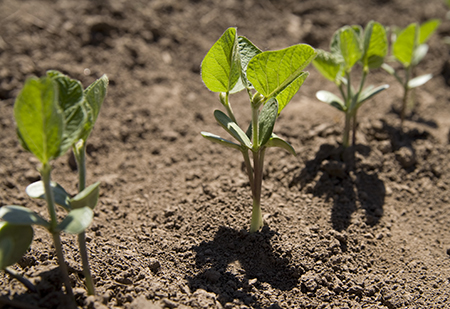
Soybeans can compensate for a lot, but they can’t compensate for plants that never made it. Soybean seedling diseases are one of the most common causes of stand loss in the Midwest, and the pathogen complex is more diverse than corn. That diversity is exactly why Renk offers the Defender treatment program. A single active ingredient isn’t enough when your field can throw Pythium, Phytophthora, Rhizoctonia, or Fusarium at you depending on soil temperature, drainage, and field history. Defender brings together the right chemistries to address these diseases.
The Four Soybean Seedling Diseases to Know
Pythium — Most common in the northern Corn Belt. Favors cool, saturated soils (50–77°F) and attacks quickly, before germination or right after emergence. Infected seeds are soft and rotted. Emerged seedlings have water-soaked lesions on the hypocotyl and cotyledons, pull from the soil with almost no resistance, and show poorly developed roots. Follows the wet spots in a field.
Phytophthora — Field-history-specific and warm-weather driven (>60°F soils + wet). Once it’s in a field, it comes back to the same low spots and high-clay areas when conditions repeat. The tell is a chocolate-brown discoloration that runs from the root up the stem, sometimes 6+ inches above the soil line, while the interior stays firm. After V2, this stem signature separates it cleanly from Pythium.
Rhizoctonia — Warm, drier conditions and sandy or south-facing soils. The lesions are firm, dry, and reddish-brown on the hypocotyl near the soil line, never mushy. Worth noting: a Rhizoctonia seedling infection that goes unnoticed in May can resurface as plant snap-off during summer wind events when the cortical rot weakens the stem base.
Fusarium — Follows stress, compaction, flooding, temperature swings, herbicide pressure. Causes brown to black root discoloration, but plants often stay standing with reduced vigor rather than dying outright. That makes it easy to miss and easy to blame on something else.
Quick Diagnostic Guide: Mushy, water-soaked tissue = Pythium or Phytophthora. Brown running up the stem above soil = Phytophthora specifically. Firm, dry reddish lesion on hypocotyl = Rhizoctonia. Brown-black root staining, plant still standing = Fusarium.
How to Scout Soybean Seedlings
Your scouting window is emergence through V2. After that, surviving plants are largely past the worst of the seedling disease risk, but the evidence of what happened is fading fast.
- Pull 10–15 plants from the edge of a problem area and examine the hypocotyl and roots.
- Check the soil line first, the classic Phytophthora brown line moves up the stem from the root.
- Mushy roots with no structure = oomycete. Firm reddish lesion on hypocotyl = Rhizoctonia. Brown-black lower root staining = Fusarium.
- After V2: Phytophthora shows stem discoloration above the soil line; Pythium damage stays at the hypocotyl and below.
- Count your stand, a final stand below 80,000 plants/acre (narrow rows) or 100,000 plants/acre (wide rows) costs yield. Run the math before replanting into June.
- Use a hand lens: Fusarium often shows pink-salmon tissue coloration. Phytophthora does not, it stays brown to tan.
Sources
- Crop Protection Network. “An Overview of Soybean Seedling Diseases.” cropprotectionnetwork.org (2026).
- University of Nebraska–Lincoln CropWatch. “Conditions Favor Seedling Diseases in Early Planted Corn and Soybeans.” cropwatch.unl.edu (2022).
- University of Wisconsin Extension. “Seed Treatment Fungicides — Corn and Soybean.” fyi.extension.wisc.edu (2010).
No post found

No post found
No post found
No post found
No post found
No post found
No post found
No post found
No post found